A staircase is one of the most used parts of a house, but it is also one of the easiest elements to get wrong. When stairs are too steep, too narrow, or too tight on headroom, they feel tiring and unsafe, even if they technically connect two floors. Good residential stair design is not only about fitting steps into available space. It is about balancing rise, tread, angle, and headroom so that the staircase feels natural to climb every day. Government-backed guidance in England and local U.S. residential code guidance both show the same basic principle: safe stairs depend on consistent dimensions, adequate clearance, and proportions that are not too steep.
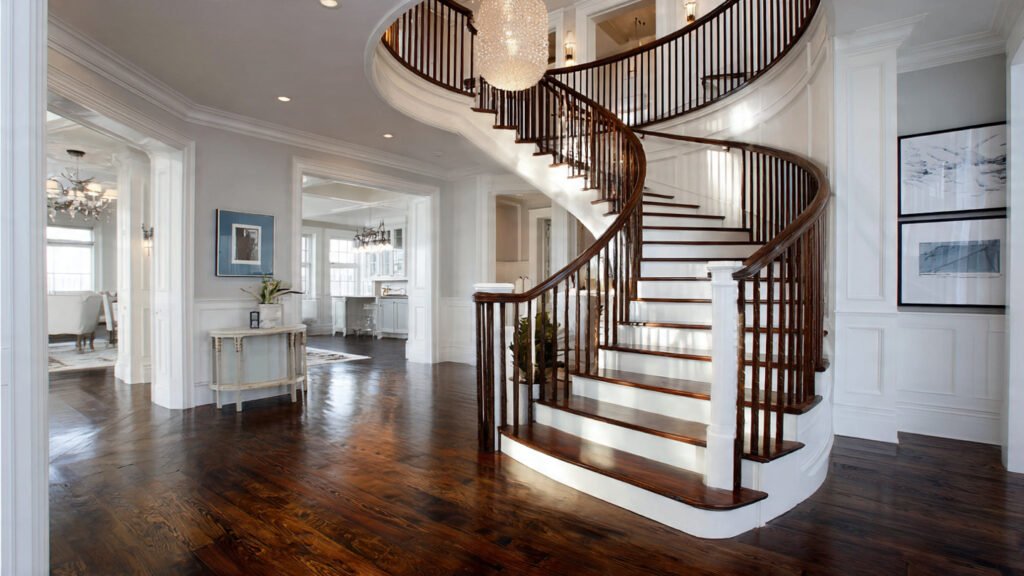
Why stair comfort matters
In homes, people use stairs while carrying laundry, groceries, luggage, and sometimes while helping children or older family members. That is why comfort matters just as much as minimum compliance. A stair that feels comfortable usually has a moderate riser, enough tread depth for secure footing, a reasonable pitch, and enough headroom that no one feels forced to duck. Approved Document K in England sets dimensional limits for private stairs, while U.S. residential guidance based on IRC Section R311.7 also requires consistent riser and tread sizes because variation within a flight increases trip risk.
Start with the rise
The rise is the vertical height from one tread to the next. If the rise is too high, climbing becomes tiring. If it is too low, the staircase becomes unnecessarily long and inefficient. For private stairs in dwellings, England’s Approved Document K gives a rise range of 150 mm to 220 mm. In U.S. residential guidance, the maximum riser height is 7 3/4 inches (196 mm). Both sources also stress that the risers within a flight should remain uniform. The U.S. residential stair guide states that the largest riser in a flight must not exceed the smallest by more than 3/8 inch (9.5 mm).
In practical residential design, comfort usually improves when you stay away from the extreme upper end of the allowed rise. A lower, more moderate rise reduces strain and helps the stairs feel easier for children, older adults, and daily repeated use. Even where code allows taller risers, many designers prefer dimensions that produce a gentler climb rather than simply squeezing the staircase into the smallest possible footprint. That is especially important in duplexes, independent houses, and internal stairs that will be used many times a day. The key point is consistency: even a small change in step height can feel awkward to the foot.
Then set the tread depth
The tread is the horizontal surface you step on. Comfortable stairs need enough tread depth for the foot to land securely. Approved Document K gives private stairs in dwellings a going range of 220 mm to 300 mm. It also states that the normal relationship between stair dimensions is 2R + G = 550 mm to 700 mm, where R is the rise and G is the going. That formula is useful because it helps balance the step rather than treating rise and tread as separate numbers. U.S. residential guidance requires a minimum tread depth of 10 inches (254 mm) and also limits variation within the same flight to 3/8 inch.
From a comfort perspective, deeper treads usually feel more secure than shallow ones, particularly when people descend the stairs. Descent is where poor stair design becomes most noticeable because the user needs a reliable footing and visual rhythm. Treads that are too short can force the foot to hang over the edge, while oversized risers combined with shallow treads create the steep, ladder-like stairs most people dislike. When working out dimensions, it helps to test the proportions with a stair calculator before finalizing drawings, because even a small adjustment in floor-to-floor height can change the number of risers and the tread layout significantly.
Keep the stair angle reasonable
The stair angle, or pitch, is what most people instinctively notice first. If a staircase feels too steep, users will often slow down, twist their body, or rely heavily on the handrail. Approved Document K sets the maximum pitch for a private stair at 42°. That is a useful upper boundary, but in a residence, comfort usually improves when the design stays comfortably below the steepest allowable condition. A stair that merely passes the limit is not always a stair that feels pleasant to use every day.
Pitch is directly affected by the relationship between rise and tread. Taller risers and shorter treads increase steepness. Lower risers and deeper treads flatten the stairs and improve comfort, but they also require more horizontal space. This is where planning matters. Designers often get into trouble when the stair location is decided too late in the house layout, and the remaining space forces an overly steep flight. It is better to establish the floor-to-floor height, approximate stair run, and landing position early in the planning stage rather than trying to fix the geometry after walls are already set.
Do not compromise on headroom
Even a well-proportioned stair can feel uncomfortable if the headroom is tight. Headroom is the vertical clear space above the walking line of the stairs. Approved Document K shows a minimum headroom of 2.0 m on the access between levels. U.S. residential stair guidance requires at least 6 feet 8 inches (2036 mm) of headroom in all parts of the stairway, measured vertically from the sloped plane adjoining the tread nosings or from the landing surface. These values are very close in practical terms and reflect the same basic safety principle: users should be able to move naturally without feeling the need to lower their head.
Headroom problems often appear near beams, slab drops, under-landings, or when a stair is forced under another flight. In compact homes, this is one of the first dimensions sacrificed, but it should not be treated lightly. Poor headroom changes body posture and makes the stairs psychologically uncomfortable, even when a person does not actually hit their head. On-site, headroom should be checked from the pitch line, not guessed visually from one point.
Landings and overall flow
Comfortable stairs are not just about individual steps. The landing matters too. U.S. residential guidance says landings should be at least the width of the stairway and extend at least 36 inches (914 mm) in the direction of travel. Approved Document K similarly requires landings at the top and bottom of flights with dimensions at least as great as the stair width. A landing gives the user a reset point, improves safety, and makes the staircase feel less abrupt.
A practical way to design residential stairs
In real projects, the most reliable workflow is simple. First, determine the floor-to-floor height. Second, estimate how much horizontal run is actually available. Third, choose a riser and tread combination that stays within code limits and produces a comfortable pitch. Fourth, verify the headroom and landing dimensions before finalizing the stair type. This is where a stair calculator becomes especially useful, because it helps check the number of risers, tread depth, total run, and stair angle before construction starts.
Final thoughts
Comfortable residential stairs are rarely the result of guesswork. They come from getting four basics right: a consistent rise, a secure tread, a moderate angle, and enough headroom. Codes provide the minimum framework, but truly comfortable stairs usually come from designing with daily use in mind, not just minimum compliance. If the staircase feels easy to climb, safe to descend, and natural in movement, the design is probably on the right track.