A successful new development should not only look impressive on completion day. It should continue to feel considered five, ten or twenty years later.
That can be surprisingly difficult. New developments often begin life with pristine paving, freshly installed boundaries and immaculate planting, but some of those features can quickly expose the site’s age. Young landscaping may feel sparse, fashionable finishes can date, and materials chosen primarily for their initial appearance may weather poorly.
Designing for longevity requires a different approach. Rather than asking what will photograph well at launch, developers and landscape designers need to consider how a place will mature.
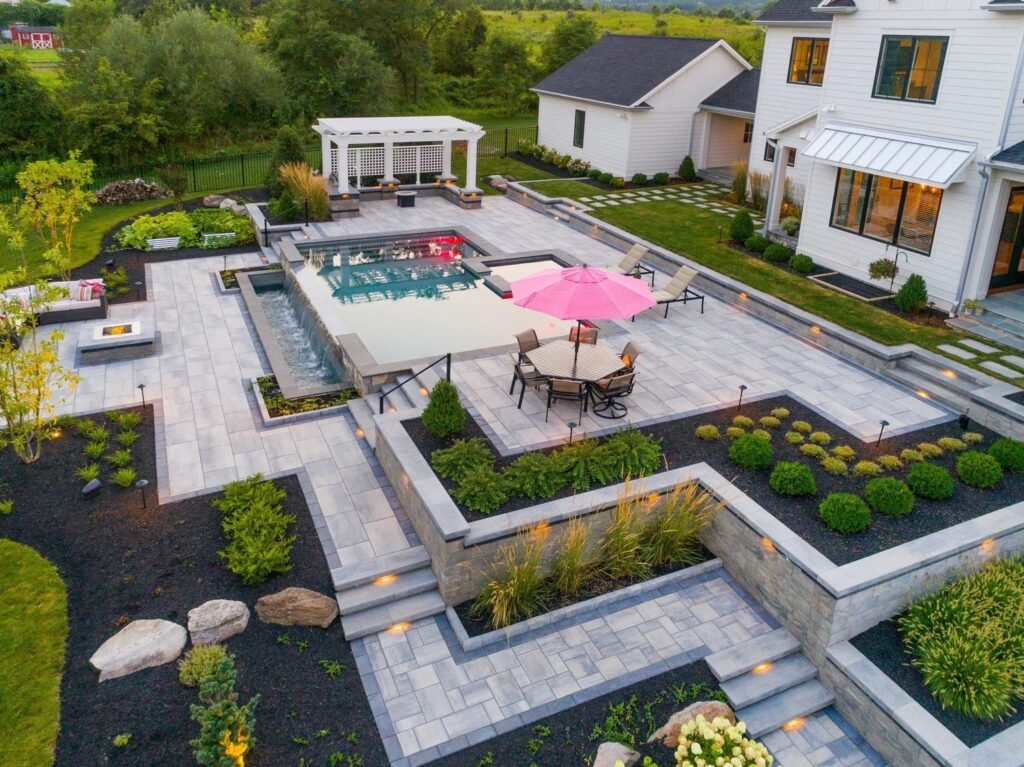
Start With Materials That Improve With Age
Some materials fight against ageing. Others make it part of their character.
Natural stone, brick, timber and certain metals can develop texture and variation as they weather. When these changes are anticipated during the design process, they can make a development feel more established rather than neglected.
This does not mean every surface needs to be traditional. Contemporary architecture can age beautifully, but the materials need to be selected with their future appearance in mind.
It is worth considering what paving will look like after years of foot traffic, how exterior finishes will respond to rain and sunlight, and whether small marks will add character or simply make the development appear tired.
Give the Landscape Presence From the Beginning
Landscaping is one of the clearest giveaways that somewhere has only recently been built. Large buildings surrounded by tiny trees, thin borders and widely spaced shrubs can create an unmistakably unfinished appearance.
Planting at greater maturity can reduce that contrast.
For larger schemes, UK rootball hedges can introduce more established structure around boundaries, pathways and communal areas. Root-balled hedging is field-grown before being lifted with soil retained around the roots, allowing larger specimens to provide greater presence from the point of planting.
Hedges can also do more than provide screening. They can divide large spaces into more human-scale areas, soften hard architectural lines, and create green corridors through a development.
The goal should not necessarily be to make landscaping look completely mature on day one, but to avoid a landscape that feels several years behind the buildings surrounding it.
Think in Layers Rather Than Empty Space
Older neighbourhoods often feel appealing because they have accumulated layers. There are trees of different heights, hedges, front gardens, walls, paths, planting and small variations between properties.
New developments can sometimes lack this depth.
Creating layers from the outset helps reduce the sense of blankness. A street might combine trees with lower planting and hedged boundaries, for example, rather than relying on a single row of identical young trees.
Different layers also mature at different speeds. Seasonal planting can provide interest while slower-growing trees establish, while hedging can create stronger definition around spaces relatively early in the development’s life.
This makes the landscape feel intentional at every stage rather than like a design waiting to become complete.
Design for Maintenance, Not Just Installation
Long-term appearance depends heavily on what happens after the contractors leave.
Complicated planting schemes may look spectacular initially but become difficult to maintain. Plants that are poorly matched to soil, exposure or available space can require continual intervention.
Designers therefore need to consider who will maintain each element and what level of care is realistic. That includes thinking about watering during establishment, pruning requirements, access for maintenance and how large individual plants will eventually become.
Simpler, robust landscaping that is properly maintained will usually age more successfully than an ambitious scheme that gradually deteriorates because its upkeep is impractical.
The same principle applies across the wider development. Materials, planting and public spaces should not merely survive ageing; they should have been selected with that ageing process in mind.
The most convincing developments are rarely those that remain frozen in the condition shown in their original architectural renders. They are places designed to acquire character as plants establish, materials weather, and people make the space their own.