
If your safety records are scattered, you already know the drill.
Incident reports in one system, audit findings in another, training logs in a spreadsheet someone maintains by hand, and chemical data in a binder nobody has updated since the last inspection.
Then the audit season arrives and someone spends three days reconciling it all, discovering along the way that a corrective action from March was never actually closed.
That gap between recording something and resolving it, is what separates these platforms. Every one of them will store an incident report. Fewer will make sure something happens next.
Here are 10 best EHS software of 2026, with the implementation timelines each one realistically requires.
How We Evaluated These Platforms
Incident forms, audit checklists, and training records are table stakes. We looked at what happens around them:
- Does one action trigger the next? A logged incident should open its own corrective action, assign an owner, and update the relevant risk assessment without anyone remembering to do it. Platforms that leave those as separate manual steps are where findings go quiet.
- Can a fix close itself? If the person who performed the corrective action can also mark it verified, your closure rate means very little. We looked for independent sign-off as a configurable requirement, not an honor system.
- Does the audit trail build itself? Regulators and certification bodies want to see who did what and when. That record should be a byproduct of normal use, not something you assemble the week before an ISO 45001 surveillance visit.
- How long until it’s actually running? Not the demo, not the pilot site — the full program, with historical data migrated and people using it. Timelines here range from 30 days to two years, and that spread matters more than most feature comparisons.
- Will the frontline use it? EHS incident management lives or dies on frontline capture. A system that requires a desktop login and fourteen fields to report a near-miss will not capture near-misses. We weighted mobile capture, offline function, and how few taps it takes to report something.
- What does it cost to change? Processes shift. If every new field or workflow tweak requires a vendor ticket and a services quote, the platform gets progressively less accurate over time.
What to Look For in EHS Software
The evaluation above is how we compared them. These are the questions worth answering about your own situation before you sit through a demo.
- Which gap is actually costing you? Scattered records, missed compliance deadlines, poor near-miss reporting, and chemical data that’s out of date are four different problems with four different answers. Pick the one that hurt most in the last twelve months.
- What’s your deadline? If a certification audit or a regulatory deadline is nine months out, a platform with a twelve-to-twenty-four-month rollout doesn’t solve this year’s problem regardless of how capable it is.
- Who administers it after go-live? Some platforms assume a dedicated EHS systems owner. If your safety manager is also handling training, contractor onboarding, and site walks, configurability that requires attention becomes a liability rather than a feature.
- Where does chemical data live? SDS management and hazardous substance registers often end up outside the EHS platform entirely. If you handle chemicals in any volume, decide upfront whether that’s a separate system or part of the same one.
- What has to connect to it? HR systems for employee records, ERP for asset and site data, LMS for training completions. Integration is usually the part of implementation that runs long, so scope it before signing rather than during.
- How many sites, how many languages, how many regulators? A single-site US operation and a fifteen-country manufacturer have almost nothing in common as buyers, even though the same vendors will pitch both.
EHS Software Comparison at a Glance
| Platform | Core Strength | Best for | Typical Rollout |
| EHS Solutions by SDS Manager | Linked incident, risk & audit records | Mid to large multi-site organizations | 2–4 weeks |
| CorityOne | Occupational health depth | Healthcare, pharma, and large employers | ~6 months |
| Intelex | Configurable EHSQ workflows | Mid to large manufacturers | ~7 months |
| Enablon | Enterprise governance & risk | Global enterprises | 12–24 months |
| SpheraCloud | Process safety, high-hazard sites | Oil, gas, chemical, and mining | 12–24 months |
| Benchmark Gensuite | Broad modular app library | Mid to large multi-site organizations | 6–12 months |
| EHS Insight | Mid-market breadth, faster rollout | Mid-sized companies | ~4 months |
| Ideagen EHS | Compliance depth, regulated industries | Aerospace, defense, and regulated manufacturing | Not publicly stated |
| EcoOnline | Chemical safety + ESG reporting | Construction, manufacturing, and chemical firms | Weeks |
| Evotix | No-code, frontline-friendly | Mid to large enterprises with field teams | Not publicly stated |
1. EHS Solution by SDS Manager
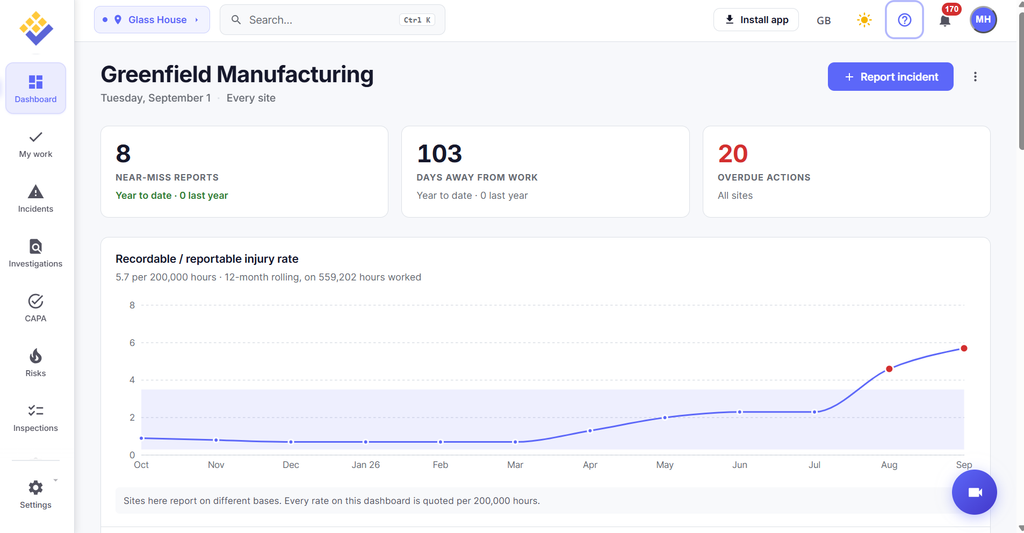
If you want incidents, audits, and risk on one record rather than three, EHS Solutions by SDS Manager is worth a look.
A logged incident opens its own corrective action and feeds the related risk score, so nothing gets copied between tools. OSHA 300, 300A, 301, and RIDDOR forms fill from the incident data, since recordability is decided at triage rather than at year end.
Closing a corrective action needs sign-off from someone other than whoever did the work, which few platforms here document. Setup is two to four weeks, configured by the vendor rather than by you.
Key features
- QR posters and mobile apps let anyone on site report without an account, working offline and syncing on reconnect.
- Triage settles recordability and notification, starting the 8-hour and 24-hour OSHA clocks automatically.
- Guided 5 Whys, fishbone, and decision tree analysis, assignable across several teams on one investigation.
- Corrective actions require an independent verifier, so the person who made the fix cannot close it out.
- Inspections run from 23,000 templates or your own checklists, scored offline with photos and signatures.
- Risk scored on a 5×5 matrix, inherent and residual side by side, with review dates that come back on their own.
- OSHA 300, 300A, and 301 with an ITA-ready export, plus RIDDOR and Australian WHS output.
Explore EHS Solutions by SDS Manager
2. CorityOne
CorityOne takes the opposite approach to EHS Solutions. Rather than getting you live quickly, it puts occupational health, exposure monitoring, and core safety management on one enterprise platform, then adds quality and ESG reporting on top of it.
If you run an occupational health clinic, track industrial hygiene sampling, or report to several regulators at once, that consolidation is the point. The trade-off is time. Plan for roughly six months from signing to go-live, including data migration, configuration, and validation.
Key features
- Occupational health module with medical surveillance, clinic visit records, and case management
- Industrial hygiene and exposure monitoring, including sampling plans and similar exposure groups (SEGs)
- Incident, audit, and corrective action management across sites
- Quality management and ESG/sustainability reporting on the same data model
- Configurable dashboards and regulatory reporting (OSHA, EU, and regional formats)
3. Intelex
Intelex builds its case on configurability. You shape the workflows, forms, and dashboards around how your sites actually operate, rather than adapting to someone else’s process.
The scope is EHSQ, meaning EHS plus quality, so a near-miss report and a product defect sit in the same system and draw on the same audit and corrective action machinery. Useful if you’re in manufacturing and tired of reconciling two sets of records. The configuration work is real, though: expect closer to seven months before you’re live.
Key features
- Configurable workflows, forms, and business rules without developer involvement
- Unified EHSQ scope covering incidents, non-conformances, and product defects
- Dashboards and reports you can adjust per site, role, or business unit
- CAPA and audit management shared across safety and quality processes
- App-based module structure, so you add functionality as your program matures
4. Enablon
Enablon is aimed at companies that treat safety as one piece of a larger risk and governance picture. The platform spans EHS, operational risk management, and sustainability reporting, with the multi-language and multi-jurisdiction support that a footprint across dozens of countries requires.
If your safety data needs to roll up alongside enterprise risk registers and CSRD disclosures, that’s the argument. It’s also why this is the longest implementation on the list; twelve to twenty-four months is normal, not a worst case.
Key features
- EHS, operational risk management (ORM), and sustainability on one platform
- Enterprise risk registers, bowtie analysis, and process safety management tools
- ESG and regulatory disclosure reporting, including CSRD and GRI frameworks
- Multi-language, multi-site deployment with country-specific regulatory content
- Integration layer for ERP, HR, and asset management systems
5. SpheraCloud
Sphera serves a narrower, higher-consequence slice of industry: oil and gas, chemicals, refining, mining. The operating assumption is different from general EHS platforms.
You’re not primarily managing slips and strains, you’re managing scenarios where a single failure takes out a unit or a community. That shows up in the depth of the process safety tooling: hazard analysis, barrier management, and risk modeling built for facilities operating under Seveso, COMAH, or OSHA PSM. Rollout matches the enterprise tier at twelve to twenty-four months.
Key features
- Process safety management with PHA, HAZOP, and LOPA workflows
- Barrier and safeguard management tied to major accident hazard scenarios
- Quantitative risk assessment and consequence modeling for process facilities
- Operational risk, control of work, and permit-to-work management
- Product stewardship and chemical compliance for regulated substances
6. Benchmark Gensuite
Benchmark Gensuite works more like a catalog than a suite. You pick the applications your program actually needs: incident reporting, inspections, compliance calendars, contractor management and leave the rest.
Benchmark Gensuite suits organizations with an uneven starting point, where one site has a mature audit program and another is still on spreadsheets. You’re not paying for or configuring modules nobody will open. The assembly work puts rollout in the middle of the field, generally six to twelve months depending on how many applications you switch on.
Key features
- Modular application library covering EHS, sustainability, quality, and operations
- Compliance calendar with task assignment and regulatory obligation tracking
- Incident, inspection, and audit management with mobile field capture
- Contractor and supplier safety qualification tracking
- Prebuilt analytics and benchmarking against peer organization data
7. EHS Insight
After several platforms asking for the better part of a year, EHS Insight reads differently. The module coverage is broad: incidents, audits, inspections, training, compliance tasks. But the implementation is scoped for teams that don’t have a dedicated project manager to assign to it.
Around four months to go live is typical. It lands well with organizations between 250 and 10,000 employees: past the point where spreadsheets hold up, not yet at the scale where an enterprise risk platform earns its configuration overhead.
Key features
- Core EHS modules covering incidents, audits, inspections, and corrective actions
- Compliance task management with automated assignment and due date tracking
- Training records and certification expiry monitoring
- Mobile app for field inspections and observations, including offline capture
- Configurable forms and dashboards without a formal implementation project
8. Ideagen EHS
Ideagen EHS spans more than fourteen modules across safety, environment, and occupational health. The design assumption is an audited environment: aerospace, defense, complex manufacturing, where a gap in your records is a finding, not an inconvenience.
Everything is built to leave a trail: who reported what, who approved it, when the corrective action closed. It sits within Ideagen’s wider regulatory compliance portfolio, so the EHS data can connect to quality and document control systems already in place at those sites.
Key features
- 14+ modules spanning safety, environmental, and occupational health management
- Audit trail and electronic records support for regulated industries
- Incident, near-miss, and corrective action workflows with approval routing
- Environmental compliance tracking, including emissions and waste reporting
- Integration with Ideagen’s quality and document control products
9. EcoOnline
EcoOnline is one of the fastest deployment on this list, plenty of customers are running inside 30 days. The reason is scope discipline: chemical safety, core EHS, and ESG reporting come preconfigured rather than built to order.
For construction, manufacturing, and chemical businesses, that means SDS management and hazardous substance registers live alongside incident reporting instead of in a separate tool with its own login and its own export.
However, you give up some configurability for that. If your processes are reasonably standard, you likely won’t miss it.
Key features
- SDS management and chemical inventory with automatic sheet updates
- Risk assessments and COSHH-style chemical exposure assessments
- Core EHS modules for incidents, observations, and audits
- ESG and sustainability reporting, including emissions tracking
- Mobile access to safety data sheets and reporting from the field
10. Evotix
Evotix bets on adoption rather than deployment speed. The reasoning is that an EHS system only works if the people on the floor actually use it, so the mobile apps are built as the primary interface rather than a cut-down version of the desktop tool.
Behind that, the no-code configuration means your safety manager can change a form, add a field, or adjust a workflow without filing a ticket and waiting two weeks. That suits mid-market and enterprise teams that expect their processes to keep changing.
Key features
- Native iOS and Android apps with offline reporting and photo capture
- No-code form and workflow configuration managed by your own team
- Incident, hazard, and near-miss reporting designed for frontline users
- Risk assessment and method statement (RAMS) management
- Training and competency tracking tied to individual roles
Picking the right one for your team
None of these platforms wins on every criterion, so the useful question is which gap is costing your team the most time right now.
If that gap is process safety at a refinery, Sphera. If its enterprise risks reporting across thirty countries, Enablon.
But most teams aren’t there.
They’re reconciling incident records in one place, audit findings in another, and chemical data in a third, while waiting out a twelve-month implementation to fix it. For that situation, EHS Solutions by SDS Manager connects those records from day one, with a rollout measured in weeks.