When a sliding door starts dragging or a window stops sealing, the default assumption on most sites is that the unit has reached the end of its life. In hot, dusty climates that assumption is usually wrong, and it is expensive. The aluminium frame is rarely the component that has failed. What has failed is almost always a consumable part worth a fraction of the assembly, and replacing the whole unit throws away a frame that had decades left in it.
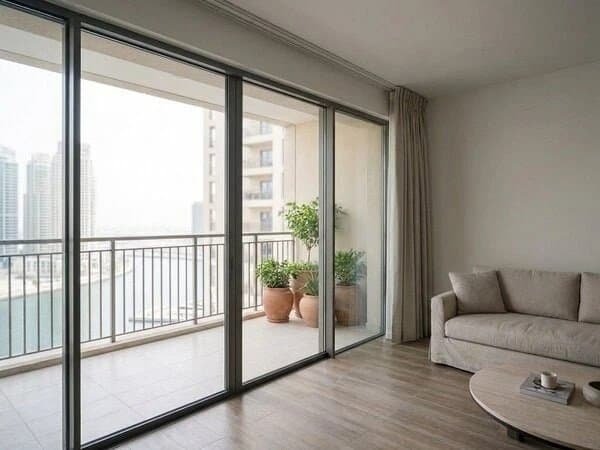
For anyone specifying, maintaining or renovating buildings in the Gulf, South Asia or any region with sustained summer temperatures above 40 degrees Celsius, understanding the actual failure sequence changes both the maintenance budget and the specification.
What actually fails first
Aluminium is dimensionally stable, corrosion resistant and effectively immortal in a dry climate. Powder-coated or anodised, it will outlast the building’s interior fit-out several times over. The parts that fail are the ones doing mechanical work or the ones made of polymer.
In order of frequency, the failure sequence in hot climates runs roughly like this. Rollers and bearings go first, usually between four and eight years. Weather gaskets and brush seals follow. Then locking hardware and handles, where the internal mechanism wears or the fixing points loosen. Hinges and friction stays on casement units come next. The frame itself, the glass and the glazing beads are almost never the problem unless there has been impact damage or a genuine installation defect.
Roughly ninety per cent of a window or door assembly’s cost sits in the frame, the glass and the labour to install it. Roughly ten per cent sits in the parts that actually break. Replacing the unit to fix a roller is a ten-to-one waste.
Thermal movement is the real load case
The failure driver most often missed in specification is thermal cycling rather than peak temperature. Aluminium has a coefficient of linear thermal expansion of around 23 micrometres per metre per degree Celsius, roughly twice that of steel and nearly three times that of concrete.
On a three metre sliding door in a climate that swings from 20 degrees at dawn to a 70 degree surface temperature on a west-facing elevation, the frame moves measurably across the day, every day, for years. That movement is not damaging in itself. What it does is work every mechanical joint in the assembly back and forth tens of thousands of times. Fixings loosen. Alignment drifts. Rollers that were square to the track when installed begin to run at a slight angle, and once they do, wear accelerates sharply.
This is why two identical doors, one in a temperate climate and one in a desert one, have completely different service intervals despite identical hardware.
Dust is the accelerant, not the cause
Fine airborne dust is often blamed for hardware failure, and it is a contributor, but it is better understood as an accelerant. Dust that settles in a bottom track becomes an abrasive paste once it mixes with humidity or cleaning water. That paste does not destroy a correctly aligned roller quickly. It destroys a slightly misaligned one very quickly indeed, because the contact patch is smaller and the loading is concentrated.
The practical implication is that track cleaning matters far less than track alignment. A building manager who cleans tracks monthly but never checks alignment is treating the symptom.
Rollers, tracks and the repair-versus-replace decision
On large sliding and lift-and-slide units, the roller set carries the entire panel weight, often eighty to a hundred and fifty kilograms per leaf on double-glazed assemblies. When a panel starts to drag, the sequence to check is: roller condition, track deformation, panel square, then frame square.
If the frame is square, the corners are sound and the track is undeformed, repair is the correct engineering answer. New rollers, new gaskets and realignment restore the assembly to as-new performance at a small fraction of replacement cost, and the work is typically completed on site within a few hours per panel. This is the point at which the choice of contractor matters more than most clients realise, because a replacement supplier and a repair specialist are looking at the same door with different commercial incentives. Firms that handle window and door repair in Dubai and comparable Gulf markets diagnose from the hardware inwards, which is the correct order; a supplier quoting a new unit has no reason to.
Replacement becomes the right answer in a narrower set of conditions than most specifiers assume. It is justified when the track is deformed beyond straightening, when frame corners have opened, when the thermal break has failed in a way that cannot be re-sealed, when the glazing specification is genuinely inadequate for the orientation, or when the profile is obsolete and hardware is no longer available. Outside those conditions, replacement is a procurement decision rather than an engineering one.
A maintenance routine that prevents most of it
The interval that matters is annual, not monthly, and the checks take about twenty minutes per opening.
Check that each panel sits square in its frame by measuring diagonals. Check that rollers run without lateral play by lifting the panel slightly at the leading edge. Inspect gaskets for chalking, hardening or shrinkage at the corners, which is where UV degradation shows first. Test that locks engage without lifting or forcing the panel, since a lock that needs help is telling you the panel has dropped. Clear tracks with a vacuum rather than water, because flushing pushes the abrasive paste deeper into the bearing races.
Adjust rollers to bring the panel back to square rather than waiting for a complaint. Most sliding hardware has several millimetres of vertical adjustment designed exactly for this, and using it is the single highest-value maintenance action available.
What this means for specification
Two changes at design stage reduce whole-life cost substantially in hot climates.
First, specify hardware for the thermal environment rather than the nominal panel weight, and confirm that the roller and gasket systems will still be available in ten years. Proprietary hardware that cannot be sourced later converts a hundred-dollar repair into a full replacement.
Second, design for access. A sliding door whose rollers can be adjusted and replaced without removing the glass is a fundamentally cheaper building to run than one where the panel must be de-glazed to reach the bearing. That difference costs nothing at specification and is almost impossible to retrofit.
Aluminium fenestration is one of the few building systems where the frame genuinely can last the life of the structure. Whether it does comes down to whether the ten per cent that wears is maintained and replaced on schedule, or whether the ninety per cent that does not wear gets thrown away with it.