Solid-state drives dominate the conversation around storage technology. They load faster, survive drops better, and have become the default choice for laptops, gaming consoles, and anything that needs quick boot times. Yet look inside almost any hyperscale data center, and rows of spinning hard drives are still doing the heavy lifting for the bulk of the world’s stored data.
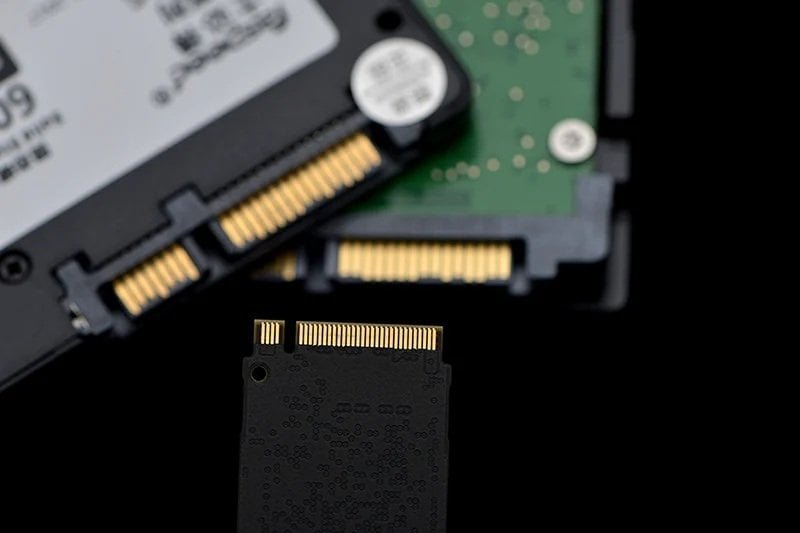
Hard drives haven’t disappeared. They’ve settled into a role that plays to their strengths: high capacity at a low cost per gigabyte, particularly for data that doesn’t need to be read constantly. Understanding why requires a look at how these drives actually work, and at the small mechanical components responsible for keeping them precise after decades of engineering refinement.
The Case for Spinning Disks Today
Even with flash prices dropping, hard drives hold a clear advantage in a handful of areas that matter most at scale.
- Cost per terabyte: A hard drive typically costs a fraction of what an SSD with equivalent capacity costs, a gap that widens further at the highest capacity tiers.
- Capacity ceilings: Current hard drives ship with capacities that flash storage hasn’t matched at a comparable price point, particularly for archival and cold storage tiers.
- Write endurance for archival use: Flash memory wears down with repeated write cycles. Data that’s written once and rarely touched again doesn’t stress a hard drive the same way.
- Established reliability data: Decades of deployment have given data center operators detailed failure-rate data for hard drives that newer flash technologies are still accumulating.
How a Hard Drive Actually Stores Data
Platters, Tracks, and Sectors
A hard drive stores information on one or more rigid platters coated with a thin layer of magnetic material. A spindle motor spins these platters at speeds that typically range from 5,400 to 15,000 revolutions per minute, depending on the drive’s intended use.
Data isn’t written across the whole platter surface at once. It’s organized into concentric tracks, and each track is further divided into sectors. This layout gives the drive a map it can use to locate any piece of data quickly, even across a platter holding trillions of individual magnetic regions.
The Read/Write Head
A read/write head, mounted on the end of an actuator arm, hovers a few nanometers above the platter surface and either reads the magnetic orientation of a given region or changes it to write new data. None of this works without extreme precision. The head has to move to an exact track location, often thousands of times per second, without ever touching the platter surface.
That movement is handled by a component most people never think about: the actuator arm’s voice coil motor.
The Actuator Arm’s Precision Problem
The voice coil motor works on a simple principle. A coil of wire sits inside a magnetic field, and running current through that coil generates a force that moves the arm. Reverse the current, and the arm moves the other way. It’s the same basic concept used in a loudspeaker, scaled down and engineered for microsecond-level positioning accuracy.
The strength and consistency of that magnetic field determines how precisely the arm can be positioned. A weak or inconsistent field means slower seek times and a higher risk of positioning errors, so drive manufacturers don’t leave magnet selection to chance. Manufacturers of these actuator assemblies typically buy wholesale neodymium magnets in volume, since even a slight variance in pull force can throw off head positioning accuracy across a production run.
Neodymium magnets are used here because they pack a strong magnetic field into a small, lightweight footprint, which matters when the actuator arm needs to move quickly without adding mass that would slow it down. That combination of strength and size is part of why hard drives have managed to keep improving seek times and data density even as the underlying storage technology has aged.
Where Hard Drives Still Dominate
Tiered Storage in the Cloud
Hard drives aren’t competing with SSDs for every workload anymore. Instead, most infrastructure teams run a tiered storage strategy that puts each technology where it performs best. Flash storage tends to sit at the top of that hierarchy, handling active workloads, databases, and anything that needs fast, random access. Hard drives sit further down, covering bulk storage, backup targets, and cold archival tiers where capacity and cost per gigabyte outweigh raw speed.
Cloud providers rely heavily on this split, since storing petabytes of infrequently accessed data on flash would be prohibitively expensive at their scale.
Surveillance and Archival Workloads
Surveillance systems, media archives, and backup infrastructure lean on hard drives for similar reasons. Video footage, in particular, is written once, rarely retrieved, and needs to be stored in enormous volume, which plays directly to a hard drive’s strengths.
What Comes Next for Magnetic Storage
Hard drive manufacturers haven’t stopped innovating just because flash storage captured the spotlight. Two newer recording techniques, heat-assisted magnetic recording (HAMR) and microwave-assisted magnetic recording (MAMR), are pushing areal density higher by allowing smaller magnetic regions to hold data reliably.
Both techniques briefly alter the magnetic properties of a platter region during the write process, either with a laser or a microwave field, which allows more data to be packed into the same physical space without losing signal stability. Drives built on these technologies are already shipping with capacities that would have seemed unrealistic a decade ago, and manufacturers show no sign of slowing that pace.
Final Thoughts
Solid-state storage has earned its place as the default for speed-sensitive workloads, but it hasn’t made hard drives obsolete. The two technologies have settled into complementary roles, and hard drives continue to carry the bulk of the world’s data because of a combination of low cost, high capacity, and mechanical engineering that has been refined for decades.
That refinement includes components that rarely get attention outside of manufacturing circles, down to the small, precisely selected magnets that keep the actuator arm moving exactly where it needs to go. As storage demands keep climbing, that precision engineering will remain just as important to a data center’s performance as the software running on top of it.