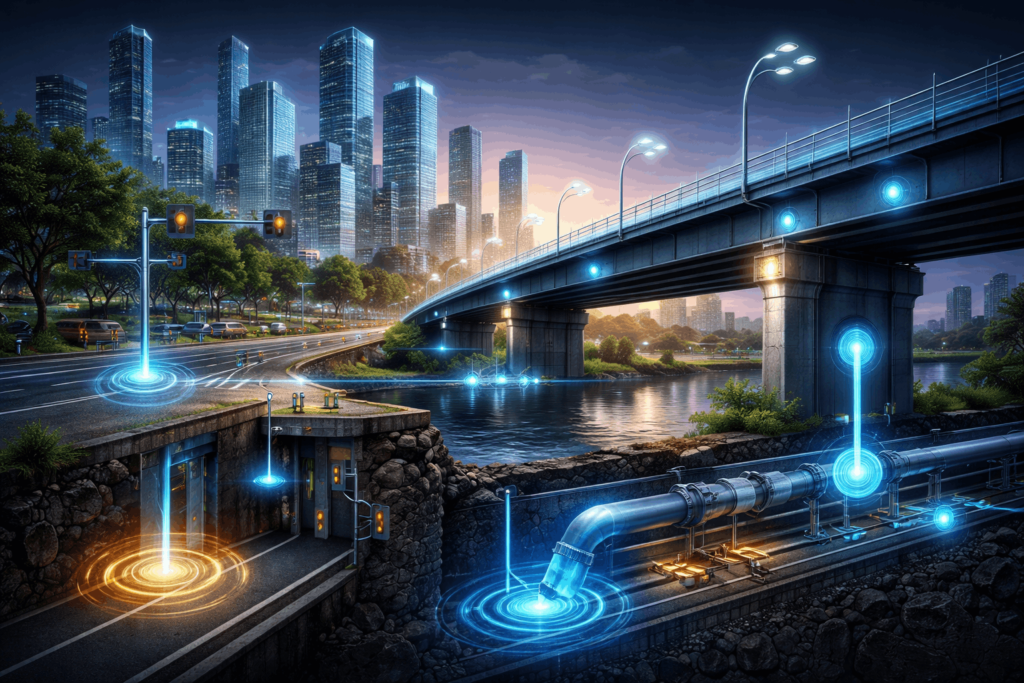
Smart cities promise safer roads, more efficient utilities, and infrastructure that adapts to growing populations. Behind most of these improvements sits an invisible network of sensors embedded in bridges, tunnels, pipelines, and buildings. These devices collect real-time data that city planners, engineers, and operators use to make faster, better-informed decisions. This article explores what hidden sensors actually do in urban environments, why they matter for long-term infrastructure health, and how cities are using them to prevent costly failures.
The Role of Sensors in Modern Urban Infrastructure
Modern cities depend on infrastructure that was built decades ago. Roads, bridges, water mains, and transit tunnels all deteriorate over time, and traditional inspection methods can’t keep pace with the scale of the problem. Sensors embedded directly into these structures give engineers a continuous stream of data about movement, stress, vibration, and temperature.
Turning raw sensor output into actionable insight requires specialized expertise in instrumentation design, installation, and data interpretation. Organizations like Sixense provide integrated monitoring solutions that connect field instruments to cloud-based platforms, giving project teams a single source of truth for structural and geotechnical performance. That level of integration helps engineers spend less time managing data and more time making decisions that keep infrastructure safe.
This shift from periodic inspections to continuous monitoring changes how cities manage risk. Instead of reacting to visible damage, operators can detect subtle changes early and intervene before conditions worsen.
What Types of Sensors Are Embedded in City Infrastructure?
The most common types include strain gauges, accelerometers, tilt meters, piezometers, and temperature sensors. Strain gauges measure how much a material stretches or compresses under load. Accelerometers detect vibrations caused by traffic, construction, or seismic activity. Tilt meters track angular movement in retaining walls, bridge piers, and building foundations.
Piezometers measure water pressure in soil, which is critical for monitoring dams, levees, and deep excavations. Temperature sensors help engineers understand how thermal expansion affects concrete and steel over daily and seasonal cycles.
More advanced instruments include automated motorized total stations (AMTS), which use laser-based measurements to track displacement across large areas with sub-millimeter accuracy. Shape arrays installed in boreholes provide continuous ground deformation data at multiple depths.
How Do These Sensors Communicate Data in Real Time?
Most sensor networks rely on wired connections, cellular modems, or wireless mesh networks to transmit data to a central platform. Wired systems offer the highest reliability and are standard for critical infrastructure like tunnels and dams. Cellular-connected sensors work well in urban areas where installing cables isn’t practical.
Cloud-based monitoring platforms aggregate data from hundreds of sensors into a single dashboard. Engineers set threshold alerts so they receive notifications when a reading exceeds a predefined limit. This makes it possible to monitor dozens of structures simultaneously from a remote location.
How Do Hidden Sensors Improve Public Safety?
Public safety is the primary driver behind most urban sensor deployments. When a bridge develops a crack or a tunnel wall shifts, the consequences of a delayed response can be severe. Sensors compress the gap between when a problem starts and when someone knows about it.
What Risks Can Sensor Networks Detect Before They Escalate?
Sensor networks detect structural displacement, ground settlement, excessive vibration, water infiltration, and abnormal load distribution. Each of these signals can indicate a developing problem that isn’t visible to the naked eye.
For example, settlement sensors installed along a pipeline corridor can detect ground movement caused by nearby construction. If the settlement rate exceeds the design tolerance, engineers can halt work and adjust the excavation plan before the pipeline is damaged.
Vibration sensors on bridges flag unusual patterns caused by overloaded vehicles or degraded expansion joints. These early warnings give maintenance teams time to investigate and schedule repairs before a closure becomes necessary.
How Does Continuous Monitoring Reduce Emergency Response Times?
Continuous monitoring eliminates the delay between inspections. Instead of discovering damage during a scheduled visit, the system reports it as it happens. Automated alerts reach the right people within minutes, which means decisions are based on current data rather than observations that may be weeks old.
In cities with aging infrastructure, this capability matters. A water main break that goes undetected for hours can flood streets, damage buildings, and disrupt traffic. Pressure sensors connected to a real-time dashboard can flag the drop immediately and trigger an automatic shutoff sequence.
What Infrastructure Systems Rely Most on Sensor Technology?
Sensor technology is used across nearly every category of urban infrastructure, but 3 systems depend on it more than others.
Bridges and Tunnels
Bridges and tunnels are high-consequence structures where failure puts lives at risk. Sensors track deflection, tilt, settlement, and vibration in real time. During construction, monitoring systems ensure that excavation work doesn’t destabilize adjacent structures. After completion, the same sensors continue operating to provide long-term performance data.
Bored tunnels in urban areas present unique challenges because they pass beneath buildings, utilities, and active roadways. Ground movement caused by tunneling must stay within tight tolerances, and the only way to verify that in real time is through a dense network of surface and subsurface sensors.
Water and Wastewater Networks
Water systems are among the oldest infrastructure assets in most cities. Leaks, pressure drops, and pipe bursts are common, and they often go undetected until they cause visible damage at the surface. Pressure sensors, flow meters, and acoustic leak detectors help utilities identify problems earlier.
Smart water networks also use sensors to optimize distribution. By monitoring pressure and flow at key nodes, operators can balance supply across districts and reduce energy consumption at pumping stations.
Transportation and Traffic Systems
Traffic sensors embedded in road surfaces count vehicles, measure speed, and detect congestion patterns. This data feeds into adaptive traffic signal systems that adjust light timing in real time to reduce delays.
Rail systems use track-mounted sensors to detect alignment shifts, rail wear, and wheel impact loads. Automated monitoring of railroad tracks helps transit agencies prioritize maintenance and avoid service disruptions caused by unexpected failures.
How Does Sensor Data Support Predictive Maintenance?
Predictive maintenance uses sensor data to forecast when a component will need repair or replacement, rather than relying on fixed schedules or waiting for something to break.
What Is Predictive Maintenance and Why Does It Matter for Cities?
Traditional maintenance follows a calendar. Inspections happen every 6 months, every year, or every 5 years, regardless of actual condition. This approach leads to 2 problems: it misses damage that develops between inspections, and it wastes resources on structures that don’t need attention yet.
Predictive maintenance solves both problems by basing decisions on real performance data. If a bridge bearing shows increasing displacement over 3 months, the maintenance team knows to inspect it now, not in 2 years when the next scheduled review comes around.
How Do Engineers Use Sensor Data to Prioritize Repairs?
Engineers rank repair priorities based on the rate of change in sensor readings, the criticality of the structure, and the potential consequences of failure. A slow, steady settlement of 2 millimeters per year on a low-traffic retaining wall is less urgent than a sudden 5-millimeter shift on a highway bridge pier.
Monitoring platforms with built-in analytics tools make this process faster. Dashboards display trend lines, flag anomalies, and generate reports that engineers can share with decision-makers. The result is a maintenance budget allocated based on evidence, not guesswork.
What Role Does Satellite and Remote Monitoring Play in Smart Cities?
Ground-based sensors provide precise, localized data, but they can’t cover every structure in a city. Satellite and remote monitoring technologies fill that gap by scanning large areas from above.
How Does Satellite InSAR Track Ground Movement Across Urban Areas?
Interferometric Synthetic Aperture Radar (InSAR) uses satellite imagery to detect ground surface displacement with millimeter-level accuracy. The technique compares radar images taken at different times to measure how much the ground has moved between passes.
InSAR is particularly useful for monitoring subsidence in areas with underground construction, mining activity, or groundwater extraction. It can cover entire metropolitan regions in a single pass, which makes it a cost-effective complement to point-based sensors on the ground.
City planners use InSAR data to identify neighborhoods that are sinking faster than expected, so they can investigate the cause and take action before buildings or utilities are affected.
When Is Remote Monitoring More Effective Than On-Site Inspections?
Remote monitoring is more effective when the area to be covered is large, access is difficult, or the rate of change is slow enough that daily readings aren’t necessary. Satellite passes typically happen every 6 to 12 days, which is sufficient for tracking gradual subsidence or regional ground movement.
For structures that require immediate alerts, like active construction zones or bridges with known deficiencies, ground-based sensors remain the better choice. The most effective monitoring programs combine both: satellites for wide-area screening and ground sensors for high-resolution, real-time data at critical points.
Challenges Cities Face When Deploying Sensor Networks
Despite the clear benefits, deploying sensor networks at scale is not straightforward. Cities face technical, financial, and organizational barriers that slow adoption.
What Are the Main Barriers to Large-Scale Sensor Adoption?
The biggest barrier is cost. Installing sensors on a single bridge or tunnel is manageable, but equipping an entire city’s infrastructure requires significant capital investment. Sensors also need ongoing maintenance, calibration, and data management, which adds to the long-term expense.
Interoperability is another challenge. Different manufacturers use different data formats, communication protocols, and software platforms. Without standardization, cities end up with fragmented systems that don’t share data easily.
Institutional inertia plays a role too. Many public agencies still rely on manual inspection programs and are slow to adopt data-driven approaches. Training staff to interpret sensor data and integrate it into existing workflows takes time and commitment.
How Can Cities Balance Cost With Long-Term Monitoring Needs?
The most practical approach is to start with the highest-risk assets. Bridges with structural deficiencies, tunnels under active construction, and aging water mains are natural candidates for early deployment. As the monitoring program proves its value through avoided failures and optimized maintenance spending, the case for expanding it to other assets becomes easier to make.
Public-private partnerships can also help spread the cost. In many large construction projects, the contractor is required to install and operate a monitoring system for the duration of the work. After the project ends, the city can take ownership of the sensors and continue using them for long-term asset management.
What the Future of Hidden Sensors Means for Urban Planning
The sensor networks being installed today are laying the foundation for a new approach to urban planning. As more cities accumulate years of continuous monitoring data, they’ll be able to model how their infrastructure behaves under different conditions, from seasonal temperature swings to extreme weather events.
Artificial intelligence and machine learning are already being applied to sensor datasets to identify patterns that human analysts would miss. These tools can detect correlations between traffic loads, weather, and structural response that help engineers design more resilient infrastructure.
The long-term vision is a city where every critical structure has a digital record of its performance over time. That data informs not just maintenance decisions but also capital planning, zoning, and disaster preparedness. Hidden sensors are the starting point for that future, and the cities that invest in them now will be better positioned to manage the infrastructure challenges ahead.
Frequently Asked Questions About Hidden Sensors in Smart Cities
What Are Hidden Sensors in Smart Cities?
Hidden sensors are monitoring instruments embedded in or attached to infrastructure like bridges, tunnels, pipelines, and buildings. They collect data on structural movement, vibration, temperature, pressure, and other conditions. The data is transmitted to a central platform where engineers and city operators use it to track performance and detect problems early.
How Do Sensors Help Prevent Infrastructure Failures?
Sensors detect small changes in structural behavior before they become visible or dangerous. For example, a tilt sensor on a retaining wall can flag gradual movement that indicates the wall is losing stability. By catching these signs early, maintenance teams can intervene before a failure occurs, avoiding costly emergency repairs and public safety risks.
What Is the Difference Between Structural Monitoring and Environmental Monitoring?
Structural monitoring focuses on the physical condition of built assets like bridges, buildings, and tunnels. It tracks displacement, strain, vibration, and load. Environmental monitoring measures conditions in the surrounding environment, such as groundwater levels, air quality, noise, and soil pressure. Many infrastructure projects use both types simultaneously to get a complete picture of how construction or operations affect the structure and its surroundings.