Modern civil and structural engineering relies heavily on fabricated metal components to deliver safe, durable, and efficient infrastructure. From transport systems to commercial buildings, sheet metal elements are embedded within both primary and secondary structures, supporting performance requirements across a wide range of applications.
As construction methods evolve, there is an increasing demand for tighter tolerances, consistent quality, and predictable mechanical behaviour. Precision fabrication is therefore no longer optional—it is a fundamental requirement for ensuring that engineered components perform as intended under real-world conditions.
Material Selection and Mechanical Properties
Material selection is a critical starting point in any sheet metal fabrication process. The choice of material must align with both structural requirements and environmental conditions.
Mild steel remains widely used due to its favourable balance of strength, ductility, and cost-effectiveness. It is commonly applied in structural supports and load-bearing assemblies where high tensile strength and weldability are required. Stainless steel, by contrast, offers superior corrosion resistance, making it suitable for external applications, marine environments, and areas exposed to aggressive chemicals.
Aluminium alloys are frequently selected for their lightweight properties and resistance to oxidation. Although they generally exhibit lower yield strength than steel, their strength-to-weight ratio makes them ideal for cladding systems, façade elements, and non-load-bearing components.
Key mechanical properties such as yield strength, ultimate tensile strength, and elongation must be carefully considered. For load-bearing applications, materials must demonstrate predictable deformation behaviour under stress, whereas non-structural elements may prioritise corrosion resistance or formability over strength.
Fabrication Processes and Tolerances
Precision in fabrication is achieved through a combination of advanced manufacturing processes and strict adherence to dimensional tolerances. Techniques such as CNC punching, laser cutting, and press braking enable the production of components with high repeatability and minimal deviation.
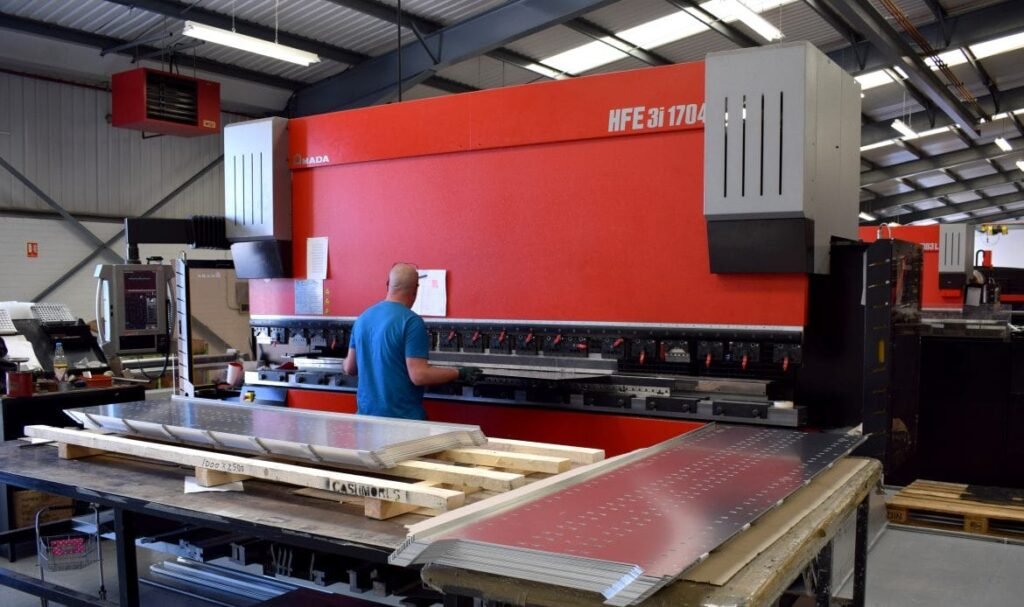
Laser cutting, in particular, allows for intricate geometries and clean edge finishes, reducing the need for secondary processing. Press braking is used to form accurate bends, where even minor deviations in angle or positioning can affect assembly alignment. Welding processes, including MIG and TIG welding, must be controlled to avoid distortion and maintain structural integrity.
Dimensional tolerances are typically defined in accordance with ISO standards, ensuring consistency across components and compatibility during installation. In structural applications, even small inaccuracies can lead to cumulative errors, affecting load distribution and connection performance.
The use of high-quality sheet metal fabrication services is therefore essential to maintain precision throughout the manufacturing process. Accurate fabrication reduces the risk of misalignment, minimises on-site adjustments, and contributes to overall structural reliability.
Applications in Civil and Structural Engineering
Sheet metal fabrication plays a versatile role across civil engineering projects. In building construction, fabricated metal is widely used in cladding systems, providing both protective and aesthetic functions. These systems must be precisely manufactured to ensure proper fitment, weather resistance, and thermal performance.
Ducting and ventilation systems also rely on fabricated sheet metal, where airtightness and dimensional accuracy are essential for efficient airflow and energy performance. Enclosures for electrical and mechanical systems require consistent fabrication to protect sensitive equipment and maintain operational safety.
In structural applications, sheet metal components are used in brackets, connectors, and secondary support systems. These elements often interface with primary structural members, requiring precise alignment to transfer loads effectively.
The rise of prefabricated and modular construction has further increased the importance of precision fabrication. Components are manufactured off-site and assembled on-site, meaning that any deviation in dimensions can disrupt the entire construction sequence.
Quality Control, Standards, and Compliance
Quality control is integral to the fabrication process, particularly in engineering applications where safety and compliance are paramount. Fabricated components must meet relevant European standards, including EN specifications, and may require CE marking to demonstrate conformity.
Inspection processes are implemented at various stages of production to verify dimensional accuracy, material properties, and weld integrity. Non-destructive testing (NDT) methods, such as ultrasonic testing, radiographic inspection, and dye penetrant testing, are commonly used to detect defects without compromising the component.
Documentation and traceability are also important. Material certificates, inspection reports, and fabrication records provide assurance that components meet specified requirements and can be audited if necessary.
Adherence to these standards supports not only regulatory compliance but also long-term performance and safety in service.
Precision sheet metal fabrication is a cornerstone of modern civil and structural engineering. From material selection to manufacturing accuracy and quality control, every stage of the process influences the performance and reliability of the final structure.
As construction continues to adopt digital workflows and automated manufacturing techniques, the demand for precision will only increase. Fabrication processes that deliver consistent, high-quality components will remain essential in supporting safe, efficient, and forward-thinking infrastructure development.