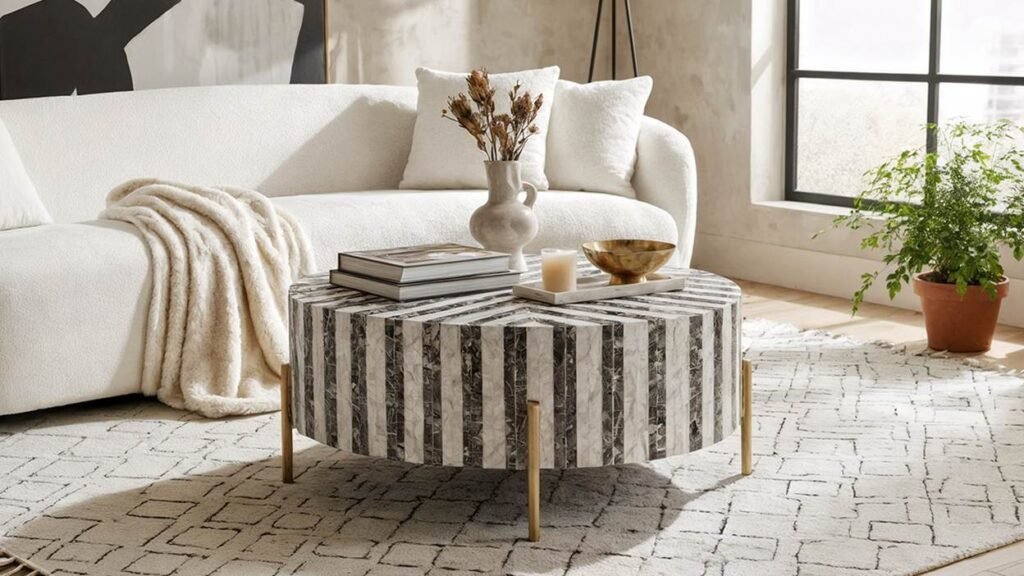
I’ll be honest, I used to hate styling my round coffee table. Not the table itself, but the way it never quite looked right no matter what I tried. After seeing how designers approach modern coffee tables for living rooms, it all suddenly made sense. Round coffee tables follow a completely different set of rules than rectangular ones. Once you understand them, styling becomes far more intuitive.
If your table never quite feels finished, these are the principles designers actually use.
Think in Thirds, Not Halves
The biggest mistake is trying to create symmetry. While this works on rectangular tables, it often feels forced on a round surface.
Instead, imagine your coffee table divided into three sections, like a pie. Style two of those sections and leave one completely empty. This creates balance without rigidity and helps the table feel intentional rather than overworked.
That empty space is not wasted. It gives the eye a place to rest and prevents the surface from feeling visually chaotic, which is especially important with circular shapes that do not have a clear beginning or end.
Build Height for Visual Interest
Round coffee tables have less surface area, so spreading objects flat can make them feel underwhelming. Designers solve this by working vertically instead of horizontally.
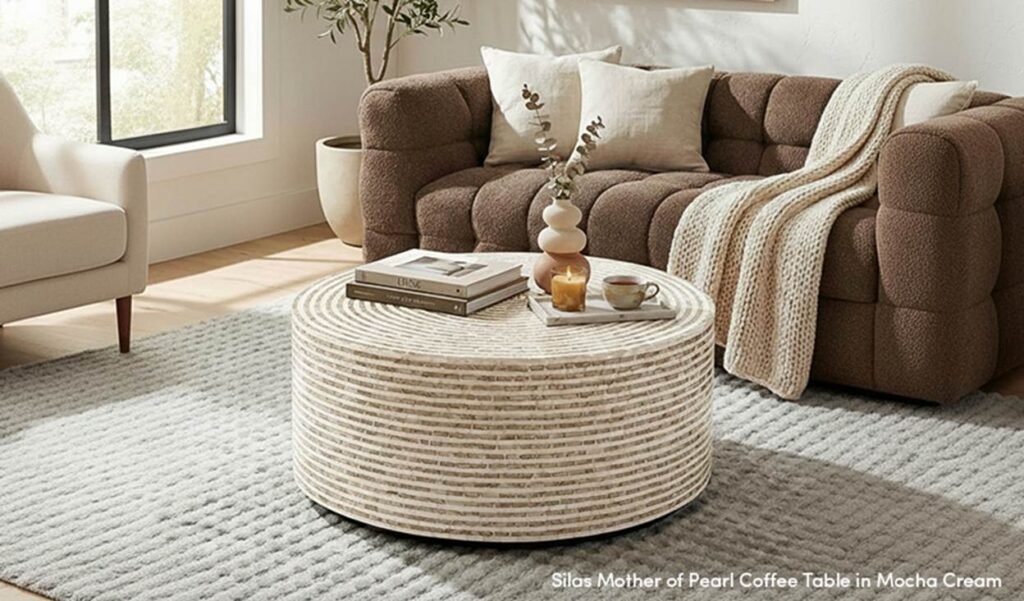
A simple formula works well: include one tall element, one medium piece and one low object. For example, a vase with branches, a small stack of books and a candle.
This layering creates depth and movement, allowing the eye to travel naturally across the table. Without variation in height, even well-chosen objects can feel flat and unconsidered.
Keep the Centre Clear
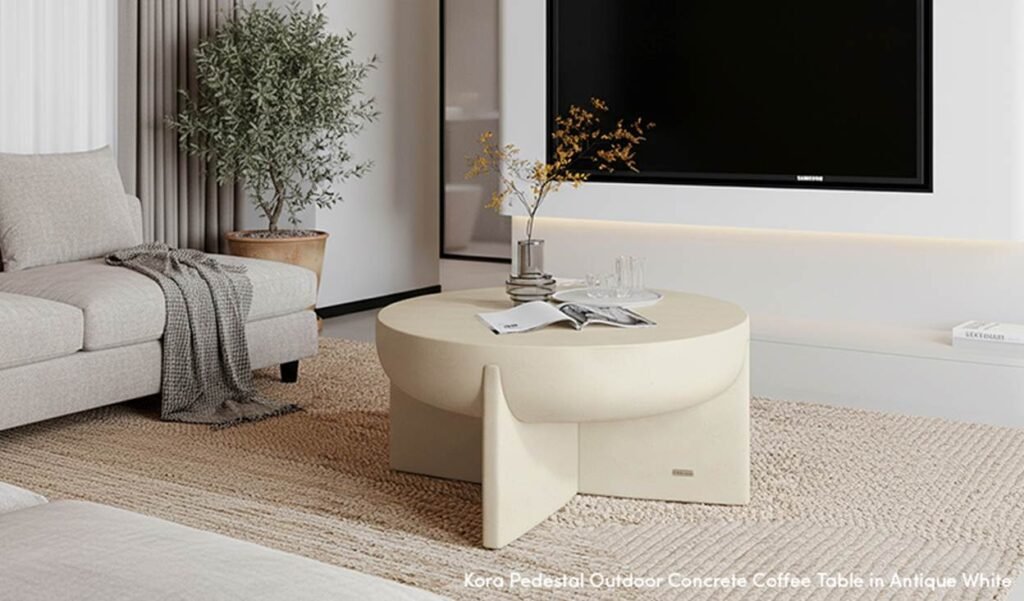
It is tempting to place a statement piece in the centre, but this often limits functionality. Large central objects block movement and make the table feel less inviting.
Round tables are designed to feel accessible. Keeping the centre clear reinforces that purpose while maintaining a clean, polished look.
If you do add something to the middle, keep it small and low. Often, leaving it empty works best.
Work with Curves, Not Against Them
A round table naturally introduces softness, so it makes sense to echo that shape with your styling. Bowls, rounded vases and organic shapes feel more cohesive than angular objects.
This does not mean avoiding all geometric pieces, but too many sharp edges can disrupt visual harmony. Curved styling works especially well in modern coffee tables for living rooms, where clean furniture lines benefit from softer decorative elements.
Embrace a Minimal Approach
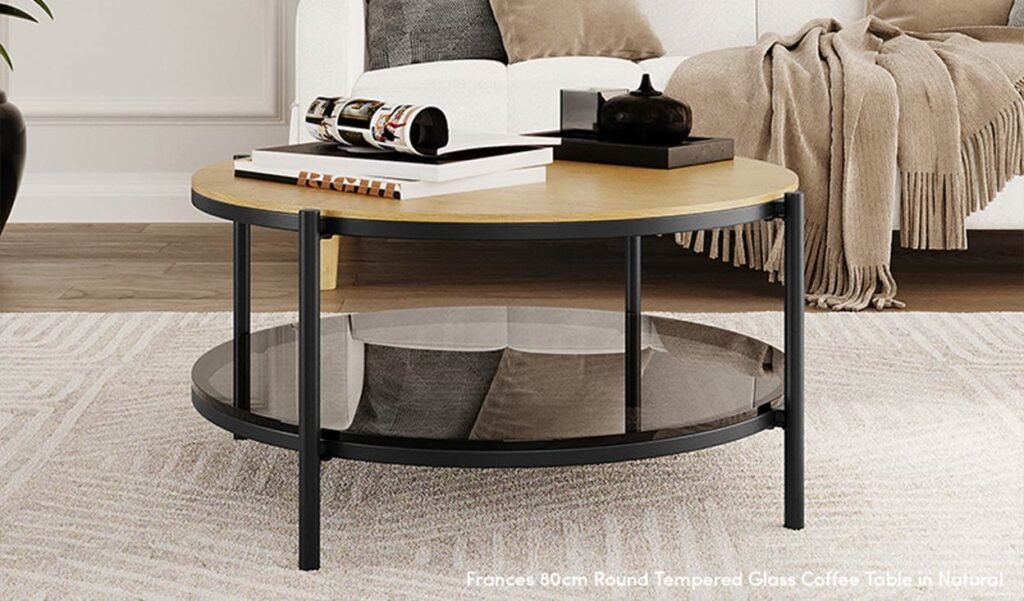
Round coffee tables rarely need many objects to look complete. Two carefully chosen pieces often create a stronger result than a crowded arrangement.
For example:
- A stack of books paired with a small plant
- A tray combined with a candle
The key is cohesion. Objects should relate through colour, material or style without being overly matched. This keeps the styling feeling relaxed and intentional.
Use a Tray to Anchor Small Items
Small objects can feel scattered on a round surface, but a tray helps group them into a cohesive display. A round or oval tray anchors the items, preventing visual chaos.
Choose a tray proportional to your table—around 15 to 25 cm works well. Avoid rectangular trays, as they can clash with the table’s curves and interrupt the flow.
Focus on Texture Over Quantity
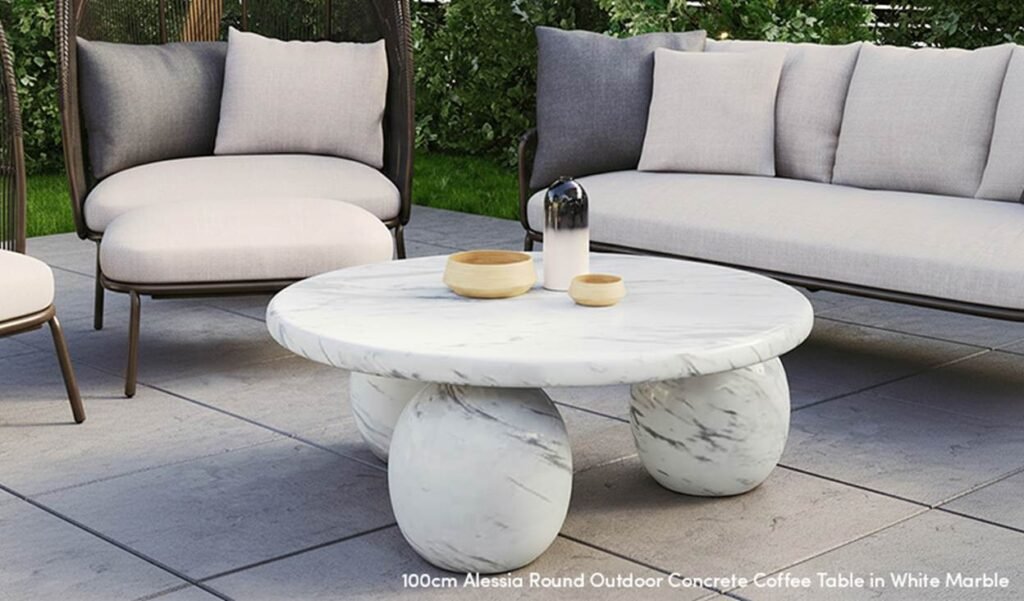
When space is limited, texture matters more than the number of objects. Mixing ceramic, glass, timber and metal adds visual interest without overcrowding.
A few well-chosen pieces with contrasting finishes will always feel more sophisticated than a larger collection of similar items. This approach adds depth and personality while keeping the table clean and polished.
Consider the Everyday View
Always check your coffee table from your main seating position. This ensures objects are visible and balanced from where you actually sit.
Round tables are viewed from multiple angles, but the primary perspective should feel intentional and harmonious.
Avoid Styling the Entire Perimeter
Placing objects around the whole edge can create clutter and confuse the eye. Instead, concentrate styling in one area and leave the rest open.
This creates a clear focal point and maintains the light, airy quality that makes round tables appealing.
A Simple Formula Designers Use
For a reliable setup, place:
- A tall object at roughly 2 o’clock
- A medium object around 7 o’clock
- A low object near 10 o’clock
This forms a triangle, which naturally balances height and spacing without overcomplicating the arrangement.
The Key to Getting It Right
Styling a round coffee table is easier when you stop trying to apply the wrong rules. It is not about symmetry, filling every space or large centrepieces.
By working in thirds, introducing height variation and leaving space empty, even space-saving round coffee table designs can look polished and inviting.
A few well-chosen objects, placed thoughtfully, will always create a more refined result than a crowded surface. The table’s shape already creates flow and softness—your job is to support it.
Start simple, refine and let the table breathe. Once you master this, styling a round coffee table is quick, effortless and looks professionally curated without feeling overdone.