In metal fabrication, helium serves two purposes. In welding, it is a component of shielding gases that changes arc behavior, increasing heat input and penetration and, under suitable conditions, allowing higher welding speeds. In quality control, helium is used as a tracer gas to test the leak tightness of welds in vessels, heat exchangers and pipelines. In both cases, the actual helium content of the gas matters.
Welding usually uses argon–helium mixtures rather than pure helium. The helium proportion affects arc characteristics, so deviations in mixture composition can affect weld quality. Where argon and helium are mixed on site, a helium analyzer installed downstream of the mixer can continuously monitor the mixture.
This article explains how helium differs from argon as a shielding gas, where it offers advantages, which mixtures are used, how gas composition affects weld quality and how helium is used to test welded assemblies.
Why Helium Changes the Welding Arc
Argon and helium are inert gases that shield the weld pool from the surrounding air. Their physical properties, however, differ substantially and influence arc behavior.
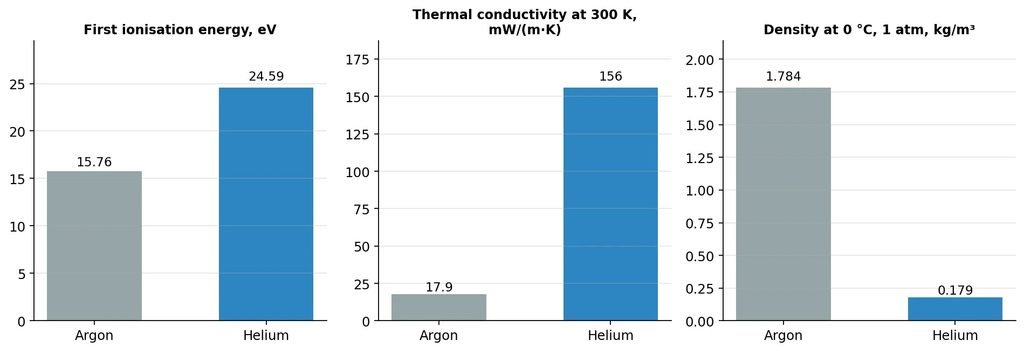
Figure 1. First ionization energy, thermal conductivity and density of argon and helium. These differences influence arc behavior and shielding-gas consumption.
- Ionization energy. The first ionization energy of helium is 24.6 eV, versus 15.8 eV for argon. Under comparable welding conditions, helium-rich arcs generally operate at higher voltage, which can increase heat input. Arc initiation in pure helium is more difficult than in argon.
- Thermal conductivity. Helium conducts heat much more effectively than argon. This changes the arc’s heat distribution and can improve heat transfer to the workpiece.
- Density. Helium is roughly ten times less dense than argon and is also lighter than air. Shielding-gas flow often needs to be increased to maintain adequate coverage, depending on torch design and welding conditions.
In practice, helium-rich shielding gases can increase penetration and welding speed, but helium is more expensive and often requires a higher volumetric flow.
Where Helium Provides Advantages
Aluminum and copper. These metals conduct heat away from the weld zone rapidly. The additional heat input available with helium-rich mixtures helps achieve penetration in thicker sections and can reduce the need for preheating.
Thick-walled structures. Increased penetration can reduce the number of welding passes and improve productivity.
Stainless steel. Some gas metal arc welding applications use ternary helium–argon mixtures with a small addition of CO₂ to improve wetting and bead shape.
Laser welding. In high-power CO₂ laser welding, a plasma plume above the weld pool can interfere with the beam. Helium is less prone to ionization and can help suppress this effect. For solid-state lasers, argon or nitrogen may be sufficient, depending on the application.
Automated and robotic welding. Potential increases in welding speed are particularly valuable on automated production lines, where cycle time affects throughput.
Which Shielding-Gas Mixtures Are Used
ISO 14175 classifies shielding gases for welding. Argon is designated I1, helium I2, and argon–helium mixtures I3.
| Gas or mixture | Typical application | Characteristics |
| Pure argon (I1) | TIG and MIG welding of aluminum and stainless steel; thin sections | Easy arc initiation, stable arc, moderate penetration |
| Argon–helium mixture (I3) | Medium-to-thick aluminum and copper; high-speed welding | Penetration tends to increase with helium content; arc starting may become harder |
| Pure helium (I2) | Thick copper and aluminum; specialized applications | High heat input; high consumption; difficult arc starting |
| Helium, argon and CO₂ | Selected GMAW applications for stainless steel | Improved wetting and bead shape |
The helium fraction in argon–helium mixtures ranges from small additions to helium-rich blends. Selection depends on the material, thickness, welding position and productivity requirements.
How Gas Composition Affects Weld Quality
A welding procedure specification (WPS) specifies the shielding gas to be used. A change in gas composition can alter arc characteristics and may require reassessment of the qualified procedure.
- Too little helium. Penetration may decrease, increasing the risk of lack of fusion, particularly when welding aluminum or copper.
- Too much helium. Arc starting can become more difficult, voltage and bead shape may change, and settings optimized for a different mixture may no longer be suitable.
- Air and moisture contamination. Oxygen and moisture can cause oxidation and porosity, particularly with reactive materials such as aluminum and titanium.
- Unstable composition. Variations in gas composition can make arc behavior inconsistent between successive workpieces and reduce process repeatability.
Shielding-gas composition should therefore be monitored where deviations are possible: during on-site mixing, when switching gas supplies and in extensive distribution systems.
On-Site Gas Mixing
Large fabrication plants may prepare argon–helium mixtures on site from cylinders, cylinder bundles or bulk supplies. A mixer meters the components; the resulting blend passes through a buffer vessel and into the distribution network feeding welding stations.
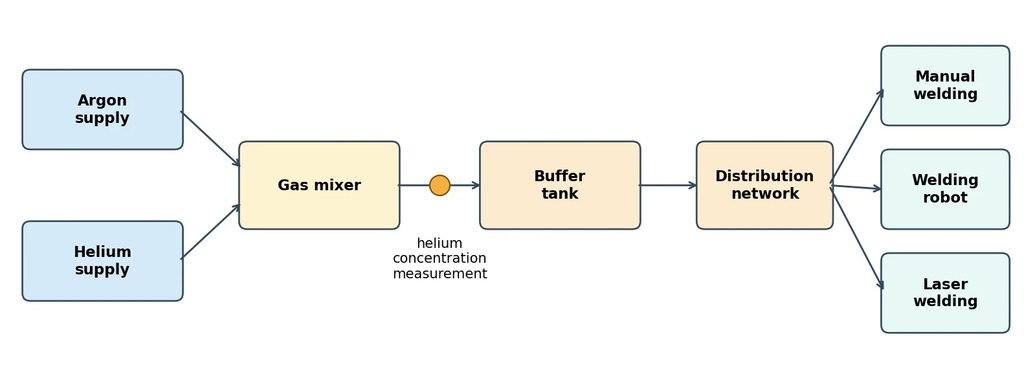
Figure 2. On-site shielding-gas mixing: argon and helium are metered into a mixer, helium concentration is checked downstream, and the blend is distributed to welding stations.
On-site mixing provides flexibility: the composition can be adjusted for different jobs and, at sufficient scale, gas costs may be reduced. But responsibility for mixture quality shifts to the plant. If the metering ratio changes—for example, because the inlet pressure of one component falls—an incorrect mixture may reach multiple welding stations.
An argon–helium blend is a binary mixture well suited to thermal-conductivity measurement. The large difference in thermal conductivity makes changes in helium concentration detectable. Continuous monitoring can trigger an alarm or interrupt gas supply when the mixture is outside specification. Calibration must match helium in argon. For mixtures also containing CO₂, the influence of the third component must be accounted for. Pressure effects likewise require control or compensation.
Helium in Quality Control of Welded Assemblies
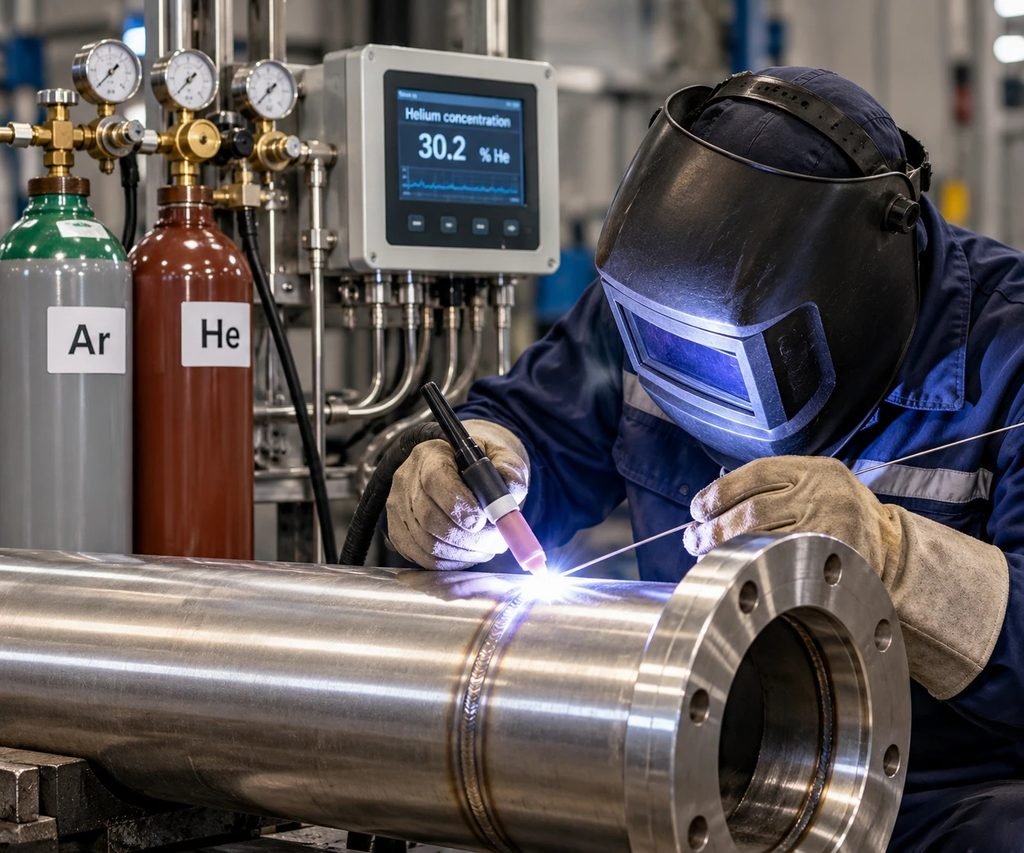
Figure 3. Welding a metal pipe assembly in a production workshop.
A second application in metal fabrication is testing finished products. Welded joints in pressure vessels, heat exchangers, vacuum chambers, pipelines and tanks may be tested for leaks using helium as a tracer gas. The method is selected according to the permissible leak rate and test conditions. EN 1779 provides guidance on choosing leak-testing methods.
Common methods for testing welded assemblies include:
- Sniffer testing. The product is pressurized with helium or a helium–nitrogen mixture, and an operator moves a leak-detector probe along the welds. The method helps locate leaks in large assemblies.
- Hood or chamber testing. The product or a section of it is enclosed, and a leak detector measures helium escaping from the assembly. Depending on the setup, this can provide an overall quantitative result.
- Vacuum testing. The product is evacuated and helium is sprayed onto the outside of its welds. This method is commonly used for vacuum equipment.
When helium–nitrogen mixtures are used to reduce cost, their composition should also be verified. A helium leak detector measures the helium component of a leak; interpreting that result in terms of the total test-gas leak rate requires knowledge of the mixture concentration and test conditions.
Working Safely with Helium and Argon
Helium and argon are nonflammable and not toxic, but they can displace oxygen. The risk is greatest in enclosed or poorly ventilated areas, inside vessels and near gas storage.
- Gas accumulation. Argon is heavier than air and can collect in pits and low-lying spaces. Helium is lighter than air and may accumulate in upper parts of enclosed spaces; actual distribution depends on ventilation and mixing.
- Oxygen monitoring. Fixed or portable oxygen monitors are used where oxygen deficiency may occur, particularly in confined spaces.
- Ventilation. Supply and exhaust ventilation should be designed for the space and the potential locations of gas accumulation.
- Cylinder and cryogenic safety. Cylinders must be secured. Liquid argon and liquid helium present cold-burn hazards and can rapidly expand into large volumes of gas as they evaporate.
How to Reduce Helium Consumption in Metal Fabrication
- Use helium where it provides a measurable benefit. Argon or argon-based mixtures may be sufficient for thin sections and many steel applications.
- Optimize the helium proportion. A lower helium content may still deliver the required penetration at lower cost.
- Set appropriate gas flow. Adjust flow to provide reliable shielding rather than using an unnecessarily large safety margin.
- Find and repair leaks in gas lines. Leaks in hoses and fittings waste gas and, under certain conditions, may allow air to enter the system.
- Use controlled on-site mixing where justified. This can provide flexibility and cost savings if mixture composition is monitored.
Questions to Ask Before Using Helium in Production
- Which materials and thicknesses are being welded? This determines whether helium offers a practical advantage.
- Which shielding gas is specified in the qualified WPS? A change may require procedure requalification.
- Is the mixture prepared by the supplier or on site?
- How is mixture composition checked at the mixer and in the distribution system?
- What is the actual shielding-gas consumption at each station? Are there leaks in the lines?
- How are finished assemblies leak-tested? If helium–nitrogen mixtures are used, is their concentration known?
Frequently Asked Questions
Why is it harder to start an arc in helium?
Helium has a substantially higher first ionization energy than argon. Starting a stable arc can therefore be more difficult, and some tungsten inert gas welding procedures start in argon or use mixtures.
Can an argon–helium mixture be replaced with pure argon without changing the welding procedure?
Not automatically. Arc behavior and penetration will change. The qualified welding procedure specifies shielding-gas requirements, and substitution may require evaluation or requalification.
Why does helium often require a higher gas flow rate?
Because helium is much lighter than argon, a higher flow may be needed to maintain adequate weld-pool shielding. The correct setting depends on the welding process and equipment.
How can an argon–helium mixture be checked at a welding station?
Portable analyzers can be used for spot checks. For continuous monitoring downstream of a mixer, a stationary analyzer provides a continuous signal. Its calibration must match helium in argon.
Does moisture in shielding gas affect weld quality?
Yes. Moisture can introduce hydrogen and oxygen into the welding environment and contribute to porosity, especially in aluminum welding. Dry gas lines and leak-tight connections are important.
Conclusion
In metal fabrication, helium is used both in shielding-gas mixtures and as a tracer gas for leak testing. In welding, it can increase heat input and penetration, particularly for aluminum, copper and thick sections, but it often requires higher flow rates and closer control of mixture composition. In quality control, helium makes it possible to detect and quantify leaks in welded assemblies. In both applications, knowing the actual helium concentration is important. Thermal-conductivity analysis is particularly suitable for continuous measurement of binary argon–helium mixtures when the instrument is calibrated for the correct gas pair and pressure effects are managed.