Two contractors walk the same backyard, look at the same 16×20 deck footprint, and send back quotes that are $8,000 apart. That’s not unusual, and it’s not random either. Every number in a deck quote comes from somewhere specific.
Once you understand the logic behind how pricing works, you can read any proposal clearly and compare deck contractors near me on a level playing field instead of just picking the lowest number and hoping for the best.
Labor: The Biggest Variable Nobody Talks About
Labor is typically 40 to 60 percent of the total project cost, and it’s the line item most contractors bundle into a single number without explanation. That’s worth pushing back on. Several things drive labor costs up or down on any given project:
- Crew experience. A senior carpenter with 15 years of deck builds charges more per hour than someone two years in. The work is faster and more precise, which affects both timeline and quality.
- Construction complexity. A flat single-level deck takes fewer hours than a multi-level build with angled corners and two stair sections. Every added element adds time.
- Site accessibility. A narrow side gate, a steep slope into the backyard, or a second-story elevation all make material handling harder and slower. That extra time shows up in the quote.
- Local market rates. Labor in a high-cost metro area runs meaningfully higher than in a smaller market, even for identical work.
A quote that doesn’t separate labor from materials leaves you with no way to evaluate what you’re actually paying for. Ask for it broken out.
Materials: Where the Spec Sheet Meets the Invoice
Materials make up the other 40 to 60 percent of most deck projects, and this is where vague quotes do the most damage. Contractors typically purchase materials at a supplier rate and add a markup of 10 to 20 percent, which is standard practice and accounts for procurement time and coordination. What’s actually in the materials portion of a quote:
- Decking boards (the surface you walk on)
- Framing lumber: joists, beams, and the ledger board attached to the house
- Hardware: joist hangers, structural screws, post bases, and flashing
- Concrete for footings
- The railing system, including posts, balusters, and top rail
- Fascia boards and skirting if included in the scope
The brand and grade of decking boards alone can shift total material cost by thousands of dollars. Trex Select and Trex Transcend are both “Trex composite,” but they’re different products at different price points with different warranty terms. A quote that just says “composite decking” tells you nothing. Ask for the exact product name, line, and color before you accept any number.
The Hidden Line Items That Inflate the Final Number
This is where two quotes that look similar on the surface start to diverge significantly. Several cost items are legitimately part of almost every project, but they don’t always make it into the initial proposal:
- Permit and inspection fees. Required in most jurisdictions and typically $100 to $500 or more, depending on project size. Sometimes listed separately, sometimes folded in, sometimes missing entirely.
- Old deck removal and disposal. If there’s an existing structure coming down, expect $500 to $2,500 added to the cost, depending on size and material.
- Site preparation. Excavation, grading, clearing tree roots near footing locations, any of these can add cost on a complicated lot.
- Material delivery charges. Especially relevant for larger orders or difficult access locations.
- Contingency buffer. A professional contractor builds in 5 to 10 percent for unexpected site conditions. If it’s not in the quote, it’ll show up as a change order later.
Two quotes that look nearly identical can actually differ by $5,000 to $8,000 once you account for which of these items each one includes or leaves out.
Why the Cheapest Quote Is Often the Most Expensive in the End
A quote that’s noticeably lower than everything else you’ve received usually means something is missing. The most common culprits: items left out of scope, unspecified materials that leave room for cheaper substitutions, no permit included, or no proof of insurance on the crew.
The change order pattern is worth understanding. Some contractors deliberately bid low to win the job, then add items mid-project once you’re committed and materials are already on site. By that point, saying no is much harder. The final invoice ends up higher than what a more transparent contractor would have charged from the start.
A concrete example: a quote that doesn’t include permit fees, old deck disposal, or post-build site cleanup can look $4,000 cheaper on paper. But those costs don’t disappear. They either hit you as add-ons during the build, or they create real problems later, like an unpermitted structure flagged during a home sale inspection.
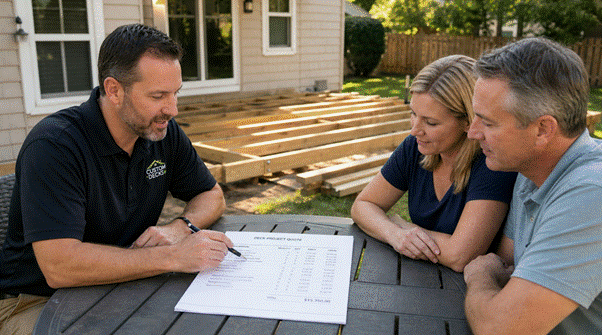
The defense is simple: ask for a fully itemized quote before you compare prices on anything.
What a Fair, Itemized Quote Looks Like
A complete, professional quote should include all of the following:
- Materials list with brand names, product lines, grades, and quantities
- Labor broken down by phase: framing, decking, railing installation, stairs
- Permit and inspection fee (stated as included or explicitly excluded)
- Delivery charges
- Site preparation costs, if applicable
- Old deck removal and disposal, if applicable
- Post-construction site cleanup
- A note on contingency or a clear statement of what is not included
- Milestone-based payment schedule tied to project phases
- Warranty terms covering both materials and workmanship
Any quote that says something like “build 16×20 deck per our discussion” as the entire scope description is not a document you can hold anyone to.
How to Compare Quotes Side by Side
You cannot meaningfully compare quotes that are built on different scopes. Before you look at the bottom line of any proposal, make sure each one covers the same ground:
- Same decking material, same brand, same product line
- Same square footage and deck configuration
- Same railing type and linear footage
- Same stair count and layout
- Permit: included or excluded (consistently across all quotes)
- Disposal: included or excluded (consistently)
Once the scope matches, then look at how each contractor breaks down labor and what their warranty terms cover. When you’re evaluating deck contractors, price is the last thing to compare, not the first. Two quotes with identical scope but a $3,000 gap in labor cost tell you something real about the crew, the timeline, and the quality of what you’re getting.