Construction workers build the places where everyone else lives and works. The dust they breathe while doing it may be killing them — slowly, irreversibly, and often without any warning until it’s too late. Attorneys specializing in silicosis and construction injuries can help injured workers recover damages for this progressive disease.
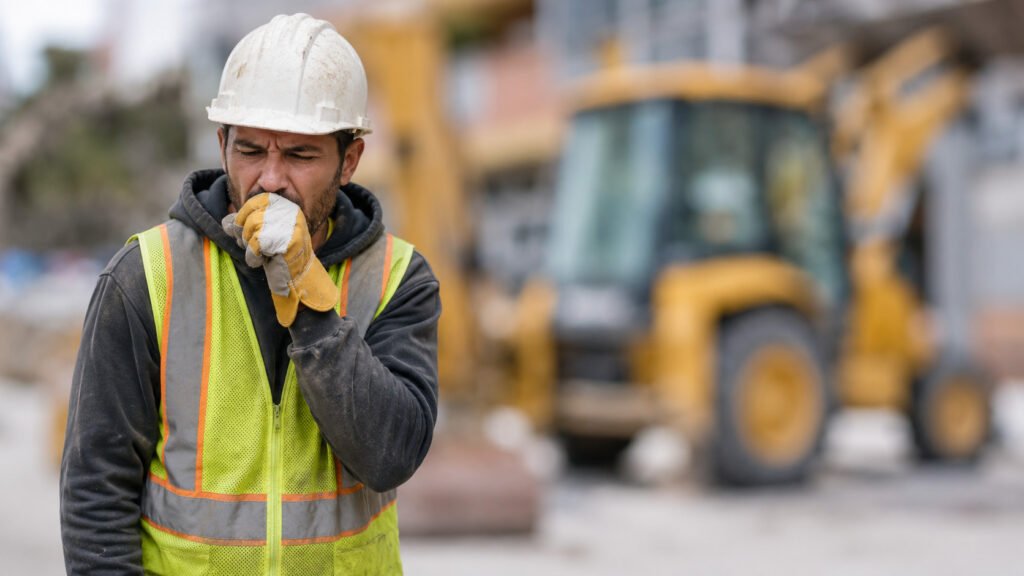
Silicosis is a lung disease caused by inhaling crystalline silica, a mineral found in sand, quartz, rock, and concrete. Exposure to silica particles causes scarring in the lungs, which can permanently harm your ability to breathe. There is no cure. Healthcare providers cannot reverse lung damage from silica dust — they can only help manage symptoms.
Who’s at Risk — and It’s a Longer List Than You Think
Silica is the second most common mineral in the earth’s crust and a major component of sand, rock, and mineral ores. Virtually any process involving movement of earth or disturbance of silica-containing products such as masonry and concrete may expose a worker to silica.
At least 1.7 million U.S. workers are exposed to respirable crystalline silica across construction, sandblasting, and mining. Almost 60,000 workers are expected to suffer from some degree of silicosis. Every year, 200 to 300 workers in the United States die with silicosis. The construction industry has one of the highest death rates from the disease.
High-risk jobs include highway and bridge construction, building demolition and repair, masonry, concrete finishing, rock drilling, and tunneling. A new study found that 1 in 10 tunnel workers may develop silicosis in their lifetime, with dangerously high exposure levels among underground construction workers, many of whom lacked proper respiratory protection.
But the crisis has expanded well beyond traditional construction trades. Engineered stone — crushed quartz mixed with resins and polymers — can contain as much as 90% silica and generates far more hazardous dust when cut than natural stone. Stone countertop fabricators who work with engineered quartz are now at the center of a public health emergency. As of early 2026, the California Department of Health has recorded more than 480 confirmed silicosis cases among engineered stone countertop workers, along with 27 deaths and 41 lung transplants since tracking began in 2019.
Three Forms, One Grim Outcome
Silicosis doesn’t come in just one version. The disease presents in three distinct ways depending on exposure intensity and duration.
Chronic silicosis is the most common type and usually develops after more than 10 years of lower-level exposure. Accelerated silicosis develops over two to five years due to heavier exposure. Acute silicosis — the most severe form — can develop within months of intense exposure and often leads to rapid respiratory failure.
Israeli physicians were among the first to document aggressive silicosis in young countertop workers as early as 1997. “In classic silicosis, you expect long exposure, decades. Here, it was much shorter,” said Dr. Mordechai Kramer, a retired pulmonologist who previously worked at Rabin Medical Center. Several patients required lung transplantation.
The warning from Israel went largely unheeded in the U.S. market for years.
Symptoms Workers Need to Recognize
The insidious part of silicosis is how unremarkable the early symptoms appear. The symptoms of silicosis are a cough with or without sputum, chest tightness, and shortness of breath, particularly on exertion. Many workers write it off as a respiratory infection or the natural wear of physical labor.
By the time symptoms are severe, significant and permanent damage has already occurred. People with silicosis are at increased risk for lung cancer, tuberculosis, chronic kidney disease, and autoimmune diseases including rheumatoid arthritis. The tuberculosis risk alone is roughly 30 times higher than for the general population.
Your Employer Has Legal Obligations — Know Them
Silicosis is entirely preventable, and federal law requires employers to prevent it. OSHA mandates engineering controls — wet drilling, dust collection systems, exhaust ventilation — as the primary line of defense. Respirators are the last resort when engineering controls alone can’t reduce exposure sufficiently.
OSHA recommends that employers medically monitor all workers who may be exposed to silica dust levels at or above one-half the permissible exposure limit. Surveillance should include a medical exam focused on the respiratory system, a chest X-ray, and spirometry screening. Testing frequency scales with exposure history: every three years for workers with fewer than 15 years of silica exposure, every two years for 15 to 20 years, and annually beyond that.
If your employer isn’t providing this, they’re likely in violation of federal law.
A Wave of Lawsuits — and an Industry Fighting Back
The legal landscape around silicosis has shifted dramatically. In August 2024, a California jury returned a $52.4 million verdict — the first and largest silicosis verdict in U.S. history — involving a 34-year-old fabricator who required a double lung transplant after 15 years of exposure. A subsequent settlement in April 2025 exceeded $26 million, involving an oxygen-dependent stone fabricator with accelerated silicosis.
Cambria, the leading quartz slab manufacturer in the U.S., alone is facing approximately 400 silicosis lawsuits. Rather than reformulate its product, the industry has taken its fight to Washington. In January 2026, manufacturers led by Minnesota-based Cambria testified before Congress in support of H.R. 5437, a bill that would eliminate the right of sick workers to sue stone manufacturers and distributors and retroactively dismiss hundreds of pending lawsuits already filed by fabricators with silicosis.
In court filings, Cambria acknowledged one plaintiff’s silicosis diagnosis but denied responsibility, arguing it had provided adequate warnings and placing blame on the fabrication shop for failing to maintain a safe workplace.
Meanwhile, the California Standards Board is expected to vote in late May 2026 on whether to advance a formal rulemaking process that could make California the first U.S. state to ban the fabrication and installation of engineered stone containing more than 1% crystalline silica.
What Workers Should Do Right Now
If you work in construction, stone fabrication, demolition, or tunneling, silicosis is an occupational hazard you cannot afford to ignore. Demand your employer’s compliance with OSHA silica standards, get regular pulmonary screenings, and document your workplace conditions.
If you’ve been diagnosed with silicosis or a related lung condition, the law may protect you. Manufacturers and employers can face liability when they fail to warn workers of known hazards or provide adequate safety controls. There are active legislative efforts to close that door permanently.