Key takeaways
- An AI agent for Meta and Google Ads is software that analyzes campaign data, decides what to change and carries out tasks toward a goal, instead of following fixed rules.
- 87% of marketers now use generative AI in at least one recurring workflow, up from 51% in 2024, according to Salesforce data compiled by Emulent.
- Adoption is broad but shallow: only 1% of organizations describe their AI deployment as mature, per McKinsey.
- Marketers trust agents most for analysis and reporting; 72% are comfortable letting agentic AI summarize data, according to GWI.
- The safest path is to start an agent on analysis and recommendations, then expand to approved actions such as pausing ads or shifting budget.
What is an AI agent for Meta and Google Ads?
An AI agent for advertising is a system that takes a goal, such as lowering cost per lead, and works out the steps to reach it across ad platforms. It reads performance data, spots problems, proposes changes and can execute them once approved.
The difference from classic automation is who decides what to do:
| Automated rules | AI agent | |
| Input | A fixed if-then condition | A goal or a question in plain language |
| Scope | One metric, one action | Many signals across campaigns and platforms |
| Output | A single change | Analysis, recommendations and multi-step tasks |
| Example | “Pause ad if CPA > $50” | “Find why Meta leads got more expensive this week and fix it” |
How widely are marketers using AI agents?
Marketers have adopted AI quickly, but agents that act on their own are still early. Most teams use AI for analysis and content, while fully autonomous decisions remain rare.
| Finding | Figure | Source |
| Marketers using generative AI in a recurring workflow | 87% (up from 51% in 2024) | Salesforce, via Emulent |
| Share of marketing budgets going to AI initiatives | 15.3% | Gartner CMO Spend Survey 2026, via Emulent |
| Organizations calling their AI deployment mature | 1% | McKinsey, via Emulent |
| Marketers testing or experimenting with agentic AI | About 1 in 5 | SAS and Coleman Parkes |
| Marketers comfortable letting agentic AI summarize data | 72% | GWI, via Talkwalker |
The gap between use and maturity is the opportunity. Advertisers who connect an agent to real Google and Meta account data, not just a chat window, move from experimenting to measurable results.
What can an AI agent do in Google and Meta Ads?
An AI agent handles the analysis-to-action loop that usually takes hours of switching between Ads Manager, Google Ads and spreadsheets. The most useful tasks fall into five groups.
| Task | What the agent does | Example prompt |
| Cross-platform analysis | Compares Google and Meta results in one view | “Which platform delivered cheaper leads last week?” |
| Diagnosis | Finds the cause behind a performance change | “Why did my CPC rise since Monday?” |
| Optimization | Recommends or applies budget, bid and audience changes | “Shift budget from low-ROAS ad sets to the top two” |
| Creative | Flags fatigued ads and drafts new variations | “Generate new versions of ads with falling CTR” |
| Reporting and alerts | Builds reports and sends notifications on set triggers | “Send me a summary every Monday and alert me if CPA doubles” |
The value is speed and coverage. An agent can check every campaign, every day, and explain its reasoning in plain language, which manual reviews rarely achieve.
How to start using an AI agent safely
Start narrow and widen the agent’s permissions as it earns trust. Gartner forecasts that more than 40% of agentic AI projects will be canceled by 2027, often because teams automate too much before results are proven.
- Connect clean data first. Verify conversion tracking in Google Ads and the Meta Pixel or Conversions API, because the agent’s decisions depend on it.
- Begin with questions, not actions. Use the agent for analysis and diagnosis for two to four weeks and compare its findings with your own.
- Approve before execution. Let the agent propose changes, then approve them one by one until its recommendations prove reliable.
- Set boundaries. Define spend caps, protected campaigns and brand rules the agent cannot override.
- Measure against a baseline. Track cost per conversion and time saved before and after adoption.
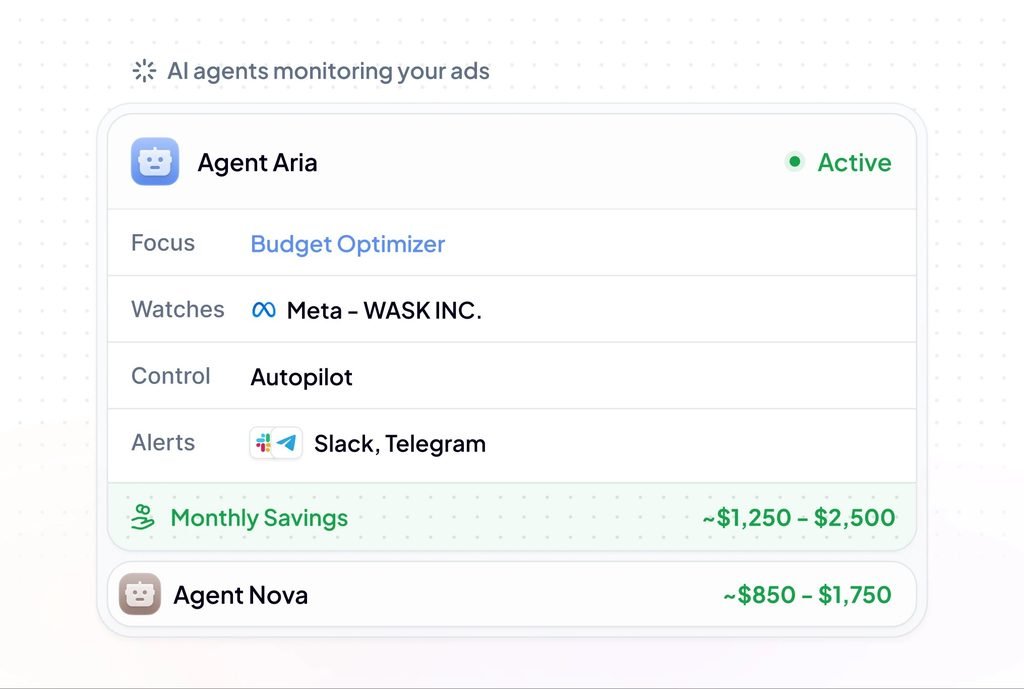
Platforms built for this workflow, such as WASK combine an AI agent, automation workflows and AI ad creative tools for Google and Meta Ads in a single dashboard, with recommendations the advertiser approves.
Frequently asked questions
Will AI agents replace PPC managers? No. Agents take over analysis and repetitive execution, while people set goals, budgets, offers and brand direction. The role shifts toward strategy and oversight.
Are AI agents safe to connect to my ad accounts? They are safe when permissions are limited, changes require approval and spend caps are in place. Choose tools that are official Google and Meta partners.
What is the difference between an AI agent and ChatGPT for ads? A general chatbot only sees what you paste into it. An advertising agent connects to live account data and can carry out approved changes inside Google and Meta Ads.Do small businesses benefit from AI agents? Often the most. Small teams lack time for daily reviews, and an agent can monitor every cam