Search the question and you’ll find the same anxiety behind it every time: someone is about to spend real money on a chandelier and wants to know it won’t look dated in five years. The short answer is that chandeliers are more popular in American homes than they have been in two decades — but the fixture wearing that name has changed almost completely. Knowing what changed is the difference between buying the comeback and buying the thing it replaced.
Why Chandeliers Came Back
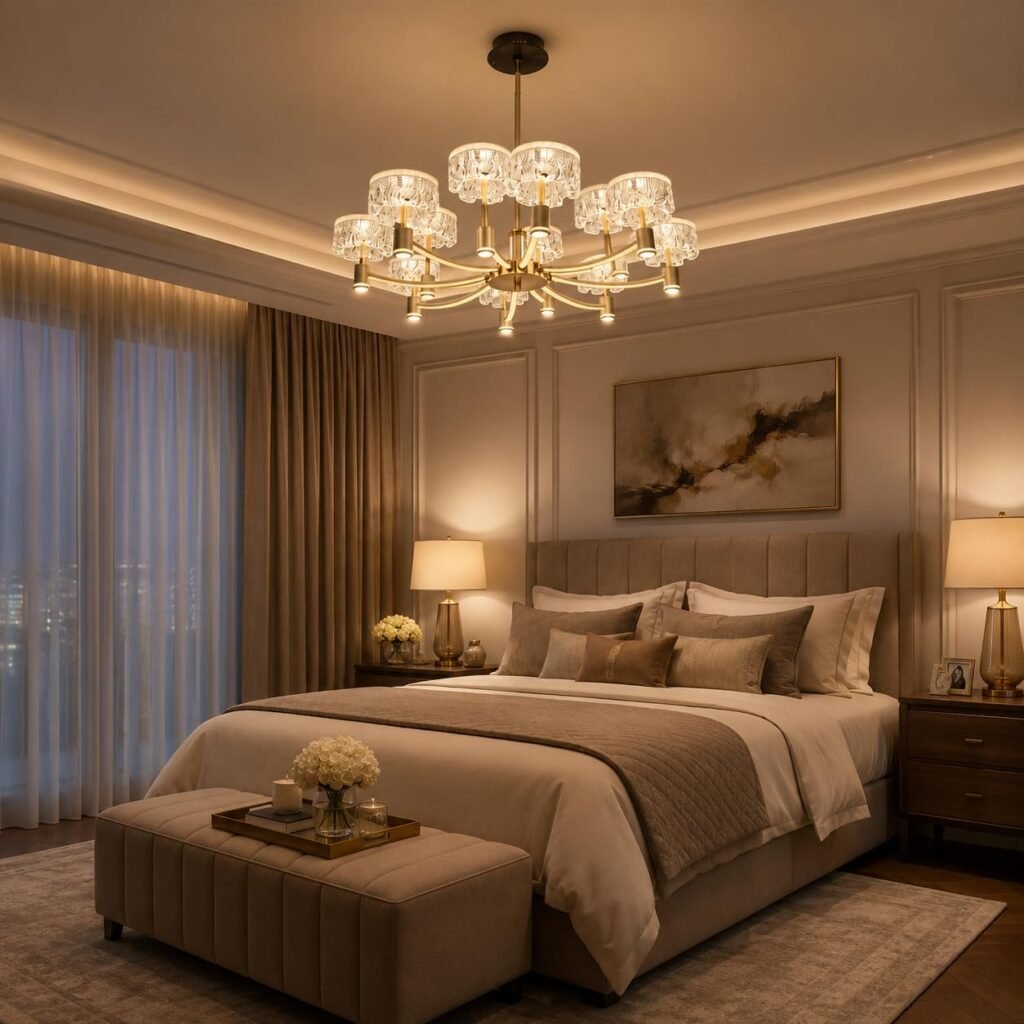
Two forces drove the return. First, open floor plans created large, connected spaces with acres of empty ceiling and no walls to decorate — the chandelier became the primary way to give those rooms a center. Second, a decade of recessed-can minimalism left homes evenly lit and visually flat; homeowners rediscovered that a room needs one object worth looking up at. The chandelier answered both problems at once, which is why it now appears in kitchens, bedrooms, bathrooms, and closets — rooms it never occupied in its formal era.
The Old Chandelier vs. the One Selling Now
| Then (1990s–2000s) | Now (2026) |
|---|---|
| Ornate candelabra arms, faux candles | Clean geometry — rings, globes, linear bars, branch forms |
| Polished brass or antique bronze only | Matte black, aged brass, mixed two-tone finishes |
| Formal rooms only (dining, foyer) | Every room, including kitchens and primary baths |
| Sized small and hung high, out of the way | Sized generously and hung low as a focal point |
| Crystal as formality | Crystal, glass, wood, and rattan as texture |
| Fixed brightness | Dimmable by default, often smart-controlled |
The pattern across every row: the chandelier stopped being a status symbol and became a design object. That shift is why the category survived the minimalism wave that killed other traditional fixtures — it adapted its forms instead of defending them.
Which Chandelier Styles Are Aging Well
Within the revival, longevity is uneven. The designs holding value across multiple trend cycles share simple geometry and honest materials:
- Glass globe clusters: in continuous production since the 1960s, equally at home in mid-century and current rooms — the closest thing to a permanent style.
- Ring and halo forms: basic geometry doesn’t timestamp; a circle of light reads current in any decade.
- Black iron frames: tied to window and door hardware trends, which move in twenty-year cycles rather than five-year ones.
- Understated crystal: crystal itself never left; only the heavily tiered formal silhouette did. Clean-lined crystal designs are outselling their ornate ancestors.
- Wood and natural-material pieces: riding the organic-modern wave, with the durability advantage that natural texture rarely reads as dated — only as rustic or refined depending on the room around it.
The styles aging fastest are the trend-specific one-offs: hyper-sculptural shapes tied to a single design moment, and novelty features like color-changing LEDs that stop being used within a month of installation.
The Real Question Behind the Question
“Are chandeliers in style” usually means “will this purchase embarrass me later” — and the honest answer is that datedness comes from sizing and placement errors more than from style choice. A well-proportioned fixture from a less fashionable family outlasts a trendy one hung wrong. The rules that protect the investment: fixture diameter roughly equal to the room’s length plus width in feet (read as inches), half to two-thirds of table width when hung over dining surfaces, 30–36 in (76–91 cm) above tabletops, and 7 ft (2.1 m) of clearance over walkways. Browsing a catalog organized by room and ceiling height bakes these constraints into the search itself, which is the practical way to shop the current market without memorizing the math.
Where Chandeliers Are Heading Next
Three directions are visible in 2026 releases and worth knowing before a purchase. Integrated LED construction is becoming standard at the design-forward end — fixtures whose bodies are the light source, with no bulbs at all; buyers should verify 25,000+ hour ratings and replaceable drivers. Scale keeps creeping upward, with visually open oversized pieces normalizing in ordinary rooms, not just double-height foyers. And placement keeps spreading: the fastest-growing chandelier locations are bedrooms and bathrooms, where a small-scale fixture delivers the most noticeable upgrade per dollar in the house. None of these directions threatens a well-chosen fixture bought today; they extend the same trajectory the category has been on for a decade.
Buy the Geometry, Not the Moment
Chandeliers are not merely still in style — they are the defining fixture of the current interiors era, reinvented in cleaner forms and installed in rooms their ancestors never entered. The purchase risk was never the category; it was buying a specific trend at its peak or hanging a good fixture badly. Choose simple geometry in an honest material, size it to the room’s math, and the question of style takes care of itself for the next twenty years.