Choosing a dumpster size sounds like one of the simpler decisions in a cleanup, renovation, or construction project.
In practice, it is often more difficult than expected.
A container that is too small can fill before the project is finished, leaving debris with nowhere to go and potentially requiring another haul. A container that is unnecessarily large may take up valuable driveway or jobsite space without providing much practical benefit.
For homeowners and contractors in Kenosha, Pleasant Prairie, Southeast Wisconsin, and Northern Illinois, the better approach is to choose a dumpster based on the actual project rather than simply selecting the largest available option.
The amount of debris matters, but it is not the only consideration. Material type, weight, property access, project duration, and the way the work will progress can all affect which EcoBox dumpster size makes the most sense.
Here is what to consider before making that decision.
1. Start With the Project, Not the Dumpster
One of the easiest mistakes is trying to choose a container before thinking carefully about what will actually be thrown away.
Two projects of similar size can produce very different disposal needs.
Cleaning out a garage may generate bulky but relatively light household items. Removing a kitchen can produce cabinetry, countertops, drywall, flooring, fixtures, and packaging. A roofing project may create debris that occupies less space but becomes heavy very quickly.
Before selecting a dumpster, identify:
- What is being removed
- How much material is likely to come out
- Whether the debris is bulky or dense
- How long the project will last
- Whether debris will be generated all at once or in stages
- How much room is available for the container
This gives the dumpster provider a much clearer picture of the job.
For homeowners, describing the project is often more useful than trying to estimate the number of cubic yards without construction experience.
2. Small Cleanouts Usually Need Less Space Than Full Renovations
Not every project requires a large container.
Smaller dumpsters can be practical for projects where debris is limited and driveway space matters.
Examples may include:
- Small garage or basement cleanouts
- Decluttering before a move
- Minor bathroom updates
- Small flooring projects
- Yard cleanup
- Removal of household items
- Limited repair work
The important distinction is between a focused cleanup and a project that involves removing substantial portions of a room or structure.
The more accurately the project is described, the easier it is to determine the appropriate dumpster size.
When reviewing dumpster options from EcoBox Dumpsters, provide details about what is being removed, the approximate amount of debris, and whether any heavy or bulky materials are involved.
This information can help narrow down the container size that best fits the scope of the project.
3. EcoBox Dumpster Sizes: Which One Fits Your Project?
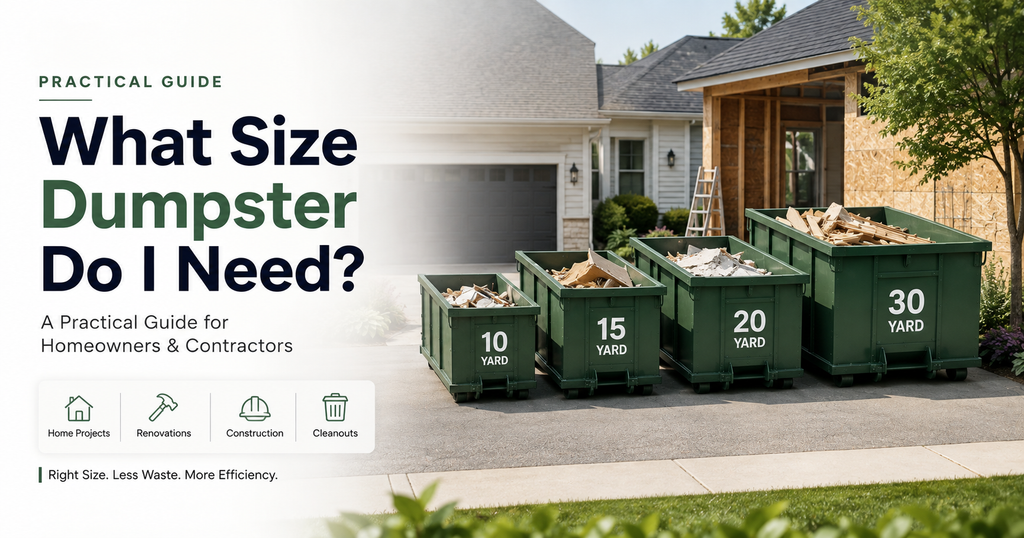
EcoBox offers three dumpster sizes designed for different types of residential and construction projects. While the right choice ultimately depends on the type and amount of debris, the following guide can help homeowners and contractors narrow down their options:
10-Yard Dumpster
A 10-yard dumpster is generally a practical choice for smaller projects that produce a limited amount of debris. It can work well for small remodels, bathroom renovations, roofing tear-offs, and lighter construction debris. For focused projects where the amount of material is relatively manageable, a 10-yard container may provide enough capacity without taking up unnecessary space.
15-Yard Dumpster
A 15-yard dumpster can be a better fit for mid-sized renovations, flooring or drywall removal, and contractor projects that generate more debris than a small remodel but do not require the capacity of a larger container. It can be useful when several types of renovation material will be removed during the same project.
20-Yard Dumpster
A 20-yard dumpster is generally suited to larger renovations, multi-room remodels, and light demolition. Projects involving multiple rooms or a more substantial amount of construction debris may benefit from the additional capacity, particularly when debris will be generated steadily throughout the project.
These size guidelines are a starting point rather than a strict formula. The type and weight of the material, available space, project duration, and expected debris volume should all be considered before selecting a container.
4. Kitchen and Multi-Room Remodels Can Fill a Dumpster Quickly
Renovation debris tends to accumulate faster than it appears inside the home.
A kitchen, for example, may contain cabinets covering several walls, countertops, flooring, drywall, old appliances, fixtures, trim, and other materials.
Once removed and placed outside, those materials occupy considerably more space.
The same applies to multi-room remodeling.
If flooring is being removed throughout the house or several rooms are being renovated at the same time, a smaller dumpster that appeared adequate at the beginning can become full surprisingly quickly.
For these projects, consider the complete demolition scope.
Ask:
Will all cabinets be removed?
Are countertops being replaced?
Is flooring coming out?
Will walls or ceilings be opened?
Are old fixtures being discarded?
Will packaging from new materials also go into the dumpster?
Looking at the entire project rather than the first stage of demolition produces a more realistic estimate.
5. Whole-Home Projects Require a Different Approach
Large renovations, estate cleanouts, major construction work, and whole-home projects generally create a more complicated debris stream.
There may be furniture and household contents during the initial cleanout, followed by demolition material, lumber scraps, drywall, flooring, packaging, and finish materials later.
In these situations, the question may not simply be, “What size dumpster do I need?”
It may be, “How should dumpsters be scheduled throughout the project?”
A large container may make sense when the property has sufficient space and debris is being generated quickly. On other sites, using an appropriately sized container and arranging exchanges as the project progresses may keep the property easier to access.
Contractors should consider how the dumpster will interact with:
- Material deliveries
- Subcontractor vehicles
- Equipment
- Trailers
- Homeowner parking
- Garage access
- Work areas
The best dumpster plan supports the jobsite rather than becoming an obstacle within it.
6. Heavy Debris Is About Weight, Not Just Volume
Dumpster sizing becomes particularly important when dealing with dense construction materials.
Roofing shingles, concrete, brick, masonry, dirt, tile, and similar debris can become extremely heavy before a container appears visually full.
That creates a different planning problem.
A homeowner may look at a partially filled dumpster and assume there is plenty of capacity remaining. From a weight standpoint, however, the container may already be approaching its allowable limit.
Projects involving heavy materials should therefore be discussed with the provider in advance.
Tell the provider specifically if the project includes:
- Roofing shingles
- Concrete
- Brick
- Masonry
- Dirt or soil
- Large quantities of tile
- Other dense demolition material
Do not assume that a larger dumpster automatically solves a heavy-material problem.
Depending on the material and project, the appropriate container or loading approach may be determined by weight restrictions rather than available space.
7. Consider How Much Space You Actually Have
Dumpster capacity is only useful if the container can be placed safely and practically on the property.
This matters especially in established neighborhoods throughout Kenosha, Pleasant Prairie, Waukegan, Gurnee, and other communities across Southeast Wisconsin and Northern Illinois, where driveway dimensions and property layouts can vary significantly.
Before ordering, look at the proposed placement area.
Consider:
- Driveway width and length
- Garage access
- Overhead branches or wires
- Slopes
- Gates or narrow entrances
- Nearby vehicles
- Property boundaries
- Space required for delivery and pickup
- Contractor access during the project
A larger dumpster may offer more capacity, but it may also consume space needed for workers, vehicles, and deliveries.
For some residential projects, a smaller container that fits the site comfortably and can be exchanged when needed may be more practical than a larger container that dominates the driveway.
8. Think About How the Debris Will Fit Inside the Container
Volume estimates can be misleading because debris does not always stack efficiently.
Long boards, cabinets, furniture, branches, doors, and irregular demolition materials can leave large pockets of unused space.
Breaking down appropriate materials before loading can make better use of the container.
For example, empty cardboard boxes take up considerably more room than flattened ones. Large cabinetry sections can create unused gaps around them. Long pieces of trim and lumber may also consume space inefficiently when placed without planning.
Contractors often become good at loading containers because they deal with debris regularly.
Homeowners doing their own cleanout may need to be more deliberate.
However, efficient loading should never mean exceeding the container’s fill line or creating an unsafe load.
9. Avoid Choosing a Dumpster Based Only on Price
It can be tempting to choose the smallest dumpster because the initial rental appears less expensive.
That decision does not always reduce the total project cost.
If the container fills halfway through demolition and another haul or container is required, the project may become more complicated than if an appropriate size had been selected initially.
At the same time, automatically choosing the largest available dumpster is not necessarily better.
The goal is not to maximize container size.
It is to match the container to the debris, property, and project schedule.
Homeowners and contractors should compare the practical details of the rental, including:
- Container size
- Included weight
- Rental period
- Types of material allowed
- Potential additional charges
- Delivery requirements
- Pickup or exchange arrangements
Understanding those details makes it easier to compare the actual cost of disposal rather than focusing only on the initial rental price.
10. Contractors Should Plan Around the Construction Schedule
For contractors, dumpster planning is part of site management.
Debris production often changes considerably from one phase of construction to another.
Demolition may fill a container quickly. Framing and mechanical work may produce less waste. Drywall, flooring, cabinetry, and finish work may create another significant wave of debris.
A practical disposal plan might consider:
Demolition phase: cabinetry, drywall, flooring, fixtures, roofing or other removed materials.
Construction phase: lumber scraps, drywall pieces, packaging and miscellaneous construction waste.
Finish phase: flooring boxes, trim scraps, fixture packaging and final cleanup material.
Planning dumpster exchanges around these stages can help keep the site organized.
It can also prevent the common situation where a full dumpster remains on the property while contractors continue creating debris.
11. When in Doubt, Describe the Job in Detail
Homeowners are not expected to calculate construction debris with perfect accuracy.
Even experienced contractors can encounter unexpected material once demolition begins.
That is why one of the most useful steps is simply providing accurate information about the project.
When contacting EcoBox Dumpsters, be prepared to explain:
- What type of project you are completing
- Approximate project size
- Which materials are being removed
- Whether heavy debris is involved
- Where the dumpster will be placed
- How long you expect to need it
- Whether the project will occur in phases
Photos of the material or proposed placement area may also be useful when a project is difficult to describe.
The more information available before delivery, the easier it is to identify a container that fits both the debris and the property.
Choosing the Right Dumpster Is Part of Project Planning
Dumpster selection should not be an afterthought.
For a homeowner, the right container can keep a garage, driveway, or yard from becoming overwhelmed with debris. For a contractor, it can help maintain an organized jobsite and provide workers with a predictable place for waste throughout construction.
The correct size depends on more than how much material appears to be coming out of the property.
The type and weight of the debris, available placement space, project duration, and construction schedule all matter.
Whether the project is a household cleanout in Kenosha, a remodel in Pleasant Prairie, a roofing job elsewhere in Southeast Wisconsin, or construction work across the border in Northern Illinois, the best approach is to plan disposal before the debris begins accumulating.
Start with the project.
Identify the materials.
Consider the property.
Then match the EcoBox dumpster to the actual work.
A few minutes spent making that decision before the project begins can prevent an undersized container, unnecessary exchanges, crowded work areas, and disposal problems later.