3D scanning on large construction sites, factories, warehouses, or commercial spaces is often more complex than it first appears.
As the site gets larger, scan paths become longer, while obstructions, corridors, and complex structures increase. Without proper planning, a corridor may be missed, blind spots may remain behind equipment or structural elements, and long continuous scans may increase the risk of drift.
So the real challenge in large-site scanning is not simply whether the scanner can keep going. It is how to turn a large, complex environment into a more controlled capture task.
Why One Long Continuous Scan Is Not Always Better
Small spaces can often be captured in a single scan, but large jobsites are different.
The longer the path, the more areas the operator has to keep track of. In environments with dense equipment, complex circulation, or heavy occlusion, simply extending the scan time does not guarantee more complete data.
A more practical approach is:
Look at the site first, then decide how to scan it.
Divide the Site Into Manageable Areas
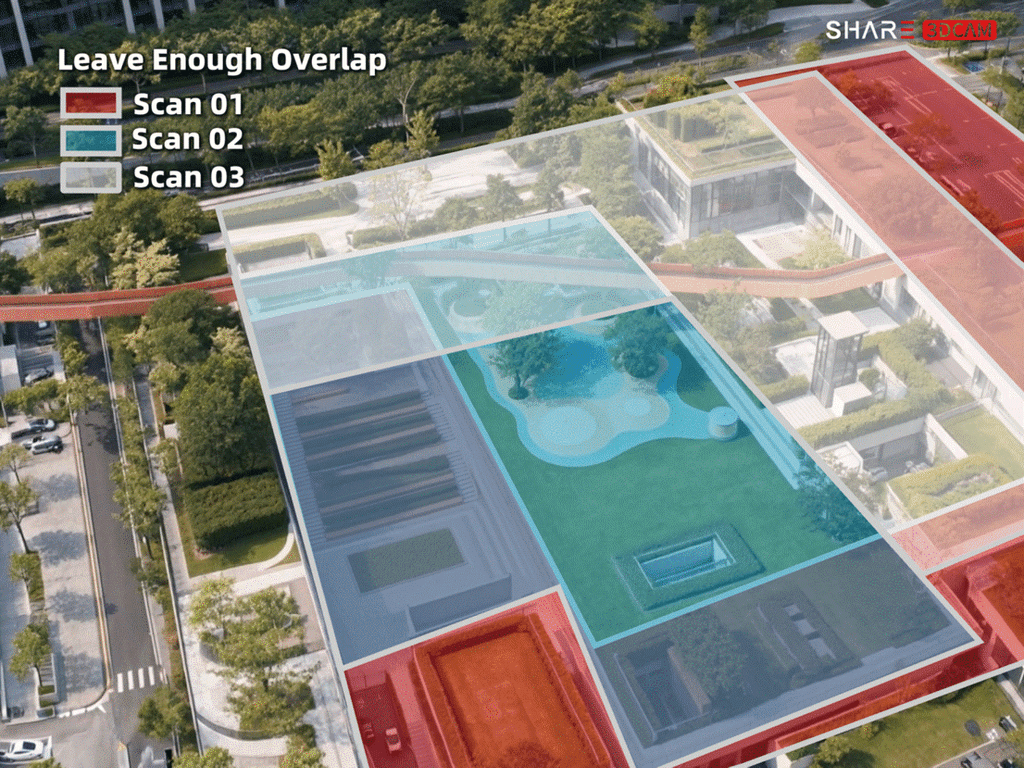
Large environments can be divided according to their actual spatial structure, such as rooms, functional zones, equipment areas, corridors, or other clear boundaries.
This serves two purposes.
First, each scan becomes easier to manage and easier to check for missing areas. Second, it reduces the risks that come with overly long continuous scan paths.
But dividing a site does not mean simply cutting it into separate pieces.
If the individual scans need to be combined later, adjacent areas should include enough overlap. Walls, columns, door openings, and other clear geometric features can provide useful references for later alignment.
Capture With the Final Integration in Mind
In real projects, the SHARE SLAM S20 can be used to capture each planned area separately.
At this stage, the goal is not only to finish each individual scan. It is also important to consider whether adjacent areas share enough common geometry and whether the scan sequence follows the actual spatial relationship of the site.
Large jobsites often require longer field sessions, so continuous operating capability also affects the pace of capture. The SHARE SLAM S20 provides around 150 minutes of working time per battery and can also be powered by an external power bank, helping reduce interruptions caused by limited battery capacity during extended fieldwork.
In other words, large-site scanning depends not only on planning the space and scan path, but also on whether the equipment can support the actual rhythm of field operations. Whether the data can be successfully combined later is partly determined during the capture stage itself.
Capture Separately, Then Rebuild the Complete Scene
After each area has been captured, the datasets can be imported into SHARE PointClouds Studiofor point cloud processing.
Once processing is complete, the point cloud registration feature in the software can be used to align and merge multiple scans based on the overlapping areas between adjacent scans, creating a more complete and unified point cloud of the site.
Check the Result After Registration
Point cloud registration is not the end of the process.
The complete scene should still be reviewed to confirm:
- whether there are obvious alignment errors
- whether key areas have been fully captured
The value of a large-site dataset is not simply that multiple scans have been merged. The goal is to create a continuous, complete, and usable digital record of the site.
Large Sites Need Better Planning, Not Just Longer Scans
The challenge of scanning large construction sites, factories, and commercial spaces is not simply whether everything can be captured in one continuous scan.
What matters is whether the site can be planned properly and whether one complex task can be broken down into smaller, more manageable capture zones.
The workflow can be summarized as:
Plan → Divide → Capture → Keep Overlap → Register → Check
For large projects, scanning longer does not always mean scanning better. Better planning matters more.
Amazon link:
US: https://tinyurl.com/bp64jnfa
UK: https://tinyurl.com/2p9v2zfr