Curious about how to build a quality home?
Don’t settle for buying into someone else’s vision.
When it comes to home construction quality, nothing is worse than buying a brand-new production-built home only to start dealing with issues shortly after moving in. Production vs. custom built homes is not really a debate when you consider the level of quality being put into your future home.
What You’re Going to Learn
- What Is Production Home Construction?
- What Is Custom Home Construction?
- The 4 Key Differences That Impact Home Construction Quality
- Which Home Building Approach Offers Better Long-Term Value?
Let’s get started.
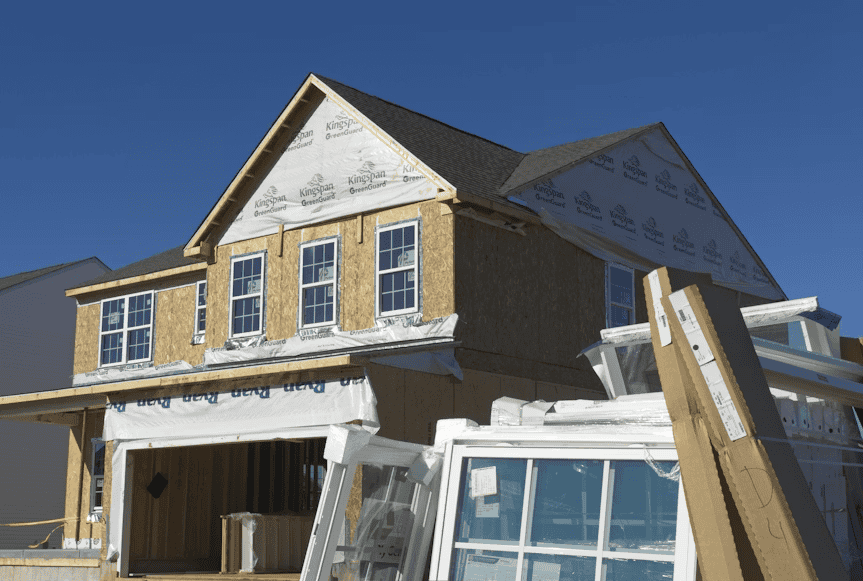
What Is Production Home Construction?
Production homes are highly-repeatable houses built across large subdivisions.
Think of them as cookie cutter houses where a builder purchases a plot of land zoned for development, lays out a neighbourhood and constructs dozens (sometimes hundreds) of nearly identical houses. Home buyers choose from anywhere between 2-6 design variants and can typically customise elements like flooring or countertops.
Here’s the kicker.
The builder needs to keep these homes moving through as fast as possible to maximise their return on investment. This process is completed by buying materials in bulk and optimising for task repetition across homes. Once again, this isn’t bad for keeping homes affordable. It just means that quality often takes a back seat.
Instead of trades showing up to build your dream home, they’re constructing dozens of homes. Your dream home now has to compete with 50 other houses for attention to detail.
What Is Custom Home Construction?
Custom home construction comes at the complete opposite end of this spectrum.
Instead of picking a home that already exists, you work with your builder to design a home from the ground up. Every single element of your home is catered to your wants and needs.
Working with a trusted custom home builder in North Vancouver means that you know home construction quality is taken seriously every step of the way. Your builder is also likely handling far fewer projects in a given year. More projects = less oversight. Less oversight = poorer home construction quality.
Instead of competing with 50 other homes for attention, your dream home is the only thing your builders will be working on at any given time.
The 4 Key Differences That Impact Home Construction Quality
Materials
Production builders need to purchase their materials in bulk which drives down costs. The problem is that those cost savings are typically reached by using “builder-grade” materials.
When talking to contractors builder-grade is code speak for “this is the cheapest thing that meets code”.
Custom builders have way more leeway when it comes to this stuff. Want solid wood doors instead of composite? Go for it. Want deluxe bathroom finishes? You got it.
Craftsmanship
According to a recent NAHB survey, roughly 75% of builders surveyed said that labour costs and availability will be their top business challenge in 2024.
When skilled labour is tight, who suffers the most? Imagine you have a construction crew that can build 2 homes at once. Now imagine they have 50 homes to build in the same subdivision. Suddenly, they need to split into five teams of workers.
Quality control suffers when teams are spread thin working on multiple homes.
Custom builds usually employ smaller crews that specialise in particular areas. With fewer projects happening at one time, there’s more time to create homes that are built WELL.
Site-Specific Design vs. Stock Plans
Speaking of built well, this feeds directly into another huge advantage of custom building — custom designs.
Production builders use stock floorplans that are essentially the same home on every lot. Unfortunately, that means things like drainage, sun exposure, and airflow don’t always line up perfectly with where your home sits.
For example, maybe your lot would benefit from a corner-to-corner attic ventilation design. Since your home is using a stock plan, those opportunities for improved home construction quality are missed.
With custom homes, your home is built around the land it’s sitting on versus trying to squeeze a stock home onto a unique piece of property.
Inspections and Oversight
Whether your home is production-built or custom built, it will have to get passed by the city’s inspectors. Structural integrity, electrical, plumbing; you name it. Inspectors will play golf until they finish checking your home.
Here’s the thing, on large production sites they only have so much time. So while a custom home may get weekly visits by the builder and inspectors, production homes are often overlooked.
Yes, both homes will have to pass inspection but accountability during the build is what really matters.
Common Quality Issues in Production Homes
Cheap Materials
As mentioned earlier, production builders need to keep those costs down. Sometimes they succeed a little too well.
Flashy trim, glossy floors and big-box faucets all look great during a home walkthrough. The problem is that the majority of them are made to be installed, survive for 10 years then get sent for recycling.
Corner Cutting
Whether it be framing, drywall, concrete work or something else. Larger builders will often cut corners to keep their homes moving along.
This usually comes up during downstream trades where they have to fix problems other teams have created.
Bad Grading
Did your dream backyard come with decent drainage? For a production home the chances are bad.
Improper grading is SUPER common in new subdivisions. Don’t get blamed for a problem that was someone else’s fault.
Foundation Settlement
Suddenly there are giant gaps between countertops and cabinets? Or maybe the floor tiles started cracking?
Chances are the home has settled. According to a review presented to the NAHB, roughly 25% of all homes in the United States will experience some form of structural defect during their lifetime. Production builders will often “dry-in” houses before they even finish things like grading or landscaping.
When heavy rains come through the neighbourhood guess which house is going to move? Exactly.
Which Home Building Approach Offers Better Long-Term Value?
While production homes can be great for first time home buyers they are greatly lacking when thinking about how a home holds value long-term.
Here’s a few things to consider:
Maintenance Expenses
This was touched on earlier but deserves more attention. Homes are only as good as their weakest material. Opting for that cheap flooring now means replacing it in 5 years.
Instead of having that headache (and financial burden) why not spend a little more now and benefit from not having to worry about it later?
Energy Savings
Did you know that custom homes can save money on energy bills?
Because every home is built to spec you can choose better windows, insulation and systems. Instead of ripping out a whole kitchen just to upgrade an HVAC system.
Resale Value
If the goal is building a home to hold as an investment then custom homes are the no-brainer option here.
Custom homes hold and increase their value due to being one-of-a-kind. Where-as production homes can easily be trumped by the 49 homes being built next door.
Pulling It All Together
Here’s the thing about production vs. custom homes. It all comes down to you!
Production Homes are great for those who need that extra financial assistance to become a homeowner. Plus they’re typically built in family friendly neighbourhoods with tons of amenities.
If you want more control over your home from start to finish and don’t mind spending a little extra on a home that will last… build custom!
Not sure which route to take? Talk to a few builders in your area. Ask the tough questions and make sure you’re comfortable with who you decide to hire.
Home construction quality shouldn’t be compromised no matter what route you choose to go.