High friction surfacing is a thin, resin-bonded layer of polish-resistant aggregate, usually calcined bauxite, applied to an existing carriageway to raise skid resistance at locations where braking and steering demand is highest. In the UK it is a specified engineering treatment rather than a decorative one, governed by Clause 924 of the Specification for Highway Works, certified under the BBA HAPAS scheme, and laid only by installers approved against that certificate. Civil engineers meet it most often on approaches to signals, pedestrian crossings and roundabout entries, and on the tight bends where the accident record justifies intervention.
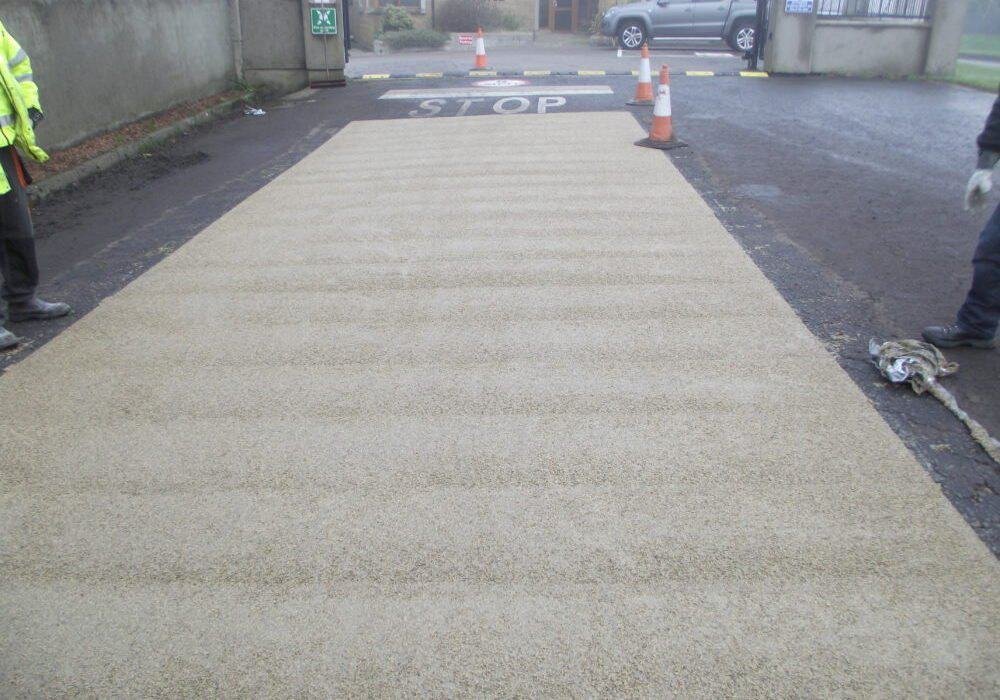
Most online explanations of high friction surfacing stop at “it makes the road grippier”. The gap worth closing is the specification chain: how a site gets identified, how the material type gets chosen, what the certificate actually certifies, and who carries the liability once the resin goes down.
Where high friction surfacing is specified
Site selection for high friction surfacing starts with skid resistance risk rather than with the product. CS 228, the National Highways standard for skidding resistance, sets the framework of site categories, investigatory levels and characteristic skid coefficient, and a site that falls below its investigatory level with a supporting collision record is the candidate. Approaches to signal-controlled junctions, uncontrolled and signalised pedestrian crossings, roundabout entry arms, steep descents into junctions and sharp horizontal curves are the classic treated locations.
Roundabouts deserve a precise word, because the popular summaries get this wrong. CD 236, the National Highways standard covering surface course materials for construction, advises against specifying high friction surfacing on the circulatory carriageway of a roundabout, including signal-controlled roundabouts, and against specifying it purely to achieve a coloured surface. The treatment belongs on the approach, where vehicles are decelerating in a straight line, not on the circulatory area where a resin system is subjected to constant turning shear and tends to fail early. Editions of both CS 228 and CD 236 are revised periodically, so the live version for the scheme should be confirmed rather than assumed.
Colour is a common source of specification drift. Buff and red systems exist for demarcation of bus lanes and cycle facilities, and a coloured surface can be a legitimate secondary benefit, but colour alone does not justify the cost of a Type 1 system. National Highways sets out the wider family of safety interventions in its guide to road safety route treatments, and on plenty of sites a thin surface course with a high polished stone value aggregate is the better long-term answer than a bonded resin overlay.
What the material actually is
A high friction surfacing system is two components working together: a binder and a calcined bauxite aggregate, typically at a nominal 1 to 3 mm size. The binder is either hot-applied, cured on site by heat, or cold-applied, using a two-part epoxy or methyl methacrylate resin that cures chemically. Hot-applied systems tend to be specified where trafficking needs to resume quickly; cold resin systems are common on smaller urban sites and where plant access is restricted.
Aggregate quality is what keeps the surface working after the first winter. The Road Surface Treatments Association Code of Practice identifies calcined bauxite as the aggregate with the established performance record for Type 1 systems, and recommends a polished stone value of 70 or above and an abrasion value of 4 or below, tested to BS EN 1097-8. Lower-grade aggregates polish, and a polished high friction surface is worse than no treatment at all because the risk assessment assumed grip that is no longer there.
System types are selected by commercial vehicle loading rather than by total traffic. Types 1, 2 and 3 exist because a crossing approach on a bus route destroys a system that would survive years on a lightly trafficked estate road. Designers should state the required type in Appendix 7/1 alongside the aggregate, colour, extent and any testing regime, rather than leaving the contractor to infer it.
What HAPAS approval covers, and what it does not
HAPAS approval is a system certification, not a product label on a tin of resin. The British Board of Agrément assesses the manufacturer’s data, factory production control, laboratory results, site installation trials and in-service performance trials before issuing a Roads and Bridges certificate, and the certificate names the binder, the aggregate and the method statement as one certified system. Substituting a different aggregate into a certified binder voids the basis of the approval.
Performance thresholds sit inside that certification and inside industry guidance. HAPAS assessment of high friction surfacing works to a minimum skid resistance value of 65, measured with the portable skid resistance pendulum tester, and the RSTA Code of Practice for high friction surfacing recommends an enhanced service target of a skid resistance value of 65 or more, a mean texture depth of at least 1.0 mm and wheel-track system loss no greater than 25 per cent, held across a five-year guarantee period for clients who require full compliance with the Code. Clause 924 as published provides for a shorter minimum guarantee, commonly two years, excluding failures caused by settlement, subsidence or collapse of the underlying carriageway. Those figures should be read against the contract edition of the documents, because the guarantee length and the acceptance criteria are exactly the clauses that get amended in project-specific appendices.
Substrate condition determines most of what happens next. A certified system laid on a surface that is contaminated, damp, fatting up with binder or too newly laid will debond regardless of the certificate number on the paperwork. Pre-installation survey, agreed patching, and honest recording of coverage rates are where the engineering judgement actually sits.
Who installs it
Installation of high friction surfacing is restricted, which surprises engineers coming to it from general surfacing work. Clause 924 requires that the certified system is installed by a contractor approved by both the certification scheme and the certificate holder, and the BBA operates a dedicated high friction surfacing installer scheme with site surveillance for exactly that reason. Specifying a HAPAS-certified system without checking the installing crew’s approval status leaves a gap that only appears when the surface fails.
On street works and utility schemes the picture is slightly different, because the anti-skid element usually arrives as part of a reinstatement obligation rather than as a standalone safety scheme. Where an excavation cuts through an existing treated area, the Specification for the Reinstatement of Openings in Highways requires the surface treatment to be reinstated to match, so the contractor closing the trench has to deliver tarmac reinstatement, line painting and the skid-resistant layer to the highway authority’s satisfaction. That is why established utility contractors carry the capability in-house rather than subletting it: McFadden Utilities, a family-run contractor based in Welwyn Garden City and trading since 1980, works for water companies, councils, developers and civils contractors across Hertfordshire, London and Surrey, and lists anti-skid surfacing alongside backfill, tarmac reinstatement, cold applied reinstatement and white lining, so one crew closes out the whole surface package instead of leaving a coloured patch for someone else to programme in.
Procurement teams should ask for three things before a shovel goes near the site: the current certificate number for the proposed system, written confirmation that the installing crew is approved by that certificate holder, and the guarantee period being offered. Two of those are free to check in advance. All three become expensive to establish after a failure.
Before you write it into the specification
Specification errors with high friction surfacing cluster in a small number of places. The extent is often drawn too short, stopping at the stop line rather than covering the full braking distance for the approach speed. The type is left unstated. The substrate age and condition requirements are omitted. Colour is specified as if it were the purpose of the work.
A clean specification names the site category and investigatory level from the skid resistance assessment, the system type, the aggregate and its declared polished stone value, the colour and the treated extent in metres, the substrate requirements, the certificate and installer approval requirements, and the guarantee period. Get those items on the drawing and into Appendix 7/1, and the rest of the process largely runs itself.
High friction surfacing earns its cost at a small number of locations where the collision record and the geometry justify it. Used there, and laid on a sound substrate by an approved crew, it is one of the most cost-effective safety interventions available to a highway engineer. Used as paint, it is an expensive way to colour a road.