Underground electrical and telecom distribution is only as reliable as the conduit system protecting it, and on demanding sites, that protection usually means a concrete-encased duct bank. Traditionally these were built in place: dig the trench, set the conduit, tie the rebar, form it, pour it, and wait. But for schedule-driven, quality-critical infrastructure, more engineers are specifying precast concrete duct banks instead. Understanding when and why is worth a civil engineer’s attention.
What a duct bank actually is?
A duct bank is an array of conduits (for power feeders, control, or communications) arranged in a fixed configuration and encased in concrete. The encasement does several jobs at once: it mechanically protects the conduits from excavation damage and ground loading, it maintains precise spacing between conduits (which matters for heat dissipation and cable ampacity), it provides fire and impact resistance, and it keeps the whole assembly stable against shifting soil and future digs.
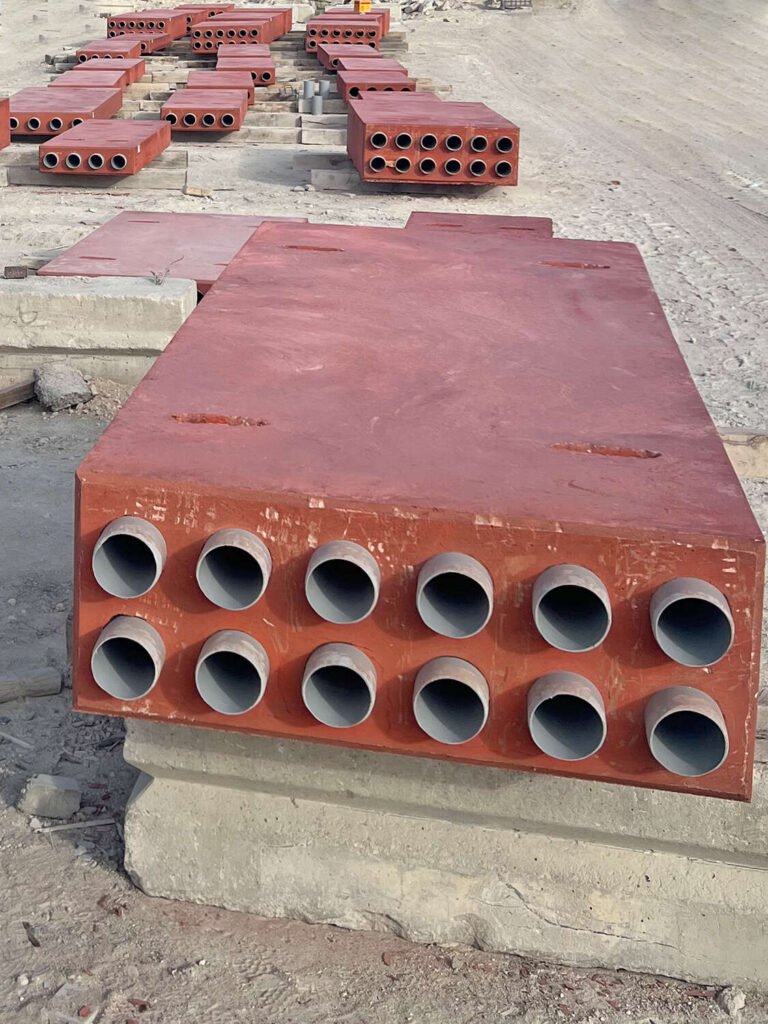
The internal geometry isn’t arbitrary. Conduit spacing, concrete cover, and the overall cross-section are engineered around the electrical load, because conductor heat has to dissipate through the concrete and surrounding soil, so the configuration directly affects how much current the system can safely carry. Rebar cages, plastic spacers, and consistent cover are what turn a bundle of pipes into a code-compliant, load-rated structure.
Cast-in-place vs. precast: where the difference shows up
Cast-in-place duct banks are formed and poured in their final trench. The method is flexible and familiar, but it puts the most important variable, concrete quality, at the mercy of the field: weather, curing conditions, consolidation around congested conduit, and crew consistency all vary day to day. It also keeps the trench open and the work on the critical path: form, pour, cure, strip, backfill, in sequence.
Precast duct banks flip that model. The encased sections are manufactured in a plant to precise steel forms, then delivered and set in the trench as finished units to be joined in the field. The trade-off is logistics (transport, crane access, and connection detailing) in exchange for a large gain in quality control and speed.
Why engineers choose precast duct banks
For the right project, precast concrete duct banks offer advantages that are hard to match with an in-place pour:
· Factory-grade quality and curing. Casting indoors on a controlled schedule removes the biggest quality variables (temperature, humidity, and curing consistency) and yields uniform strength, dense cover, and tight dimensional tolerances verified before the section ever ships.
· Dramatically shorter trench-open time. Because sections are produced in parallel with sitework, the field operation becomes set-and-connect rather than form-pour-cure. Open trenches close faster, which cuts safety exposure, traffic disruption, and weather risk.
· Consistent conduit spacing and cover. Plant fabrication guarantees the exact internal geometry the electrical design assumed, which is critical for predictable ampacity and for passing inspection without rework.
· Schedule certainty. Removing cure time from the critical path makes duct bank installation far more predictable, which is decisive on accelerated schedules and phased outages.
· Repeatable runs. Long, standardized alignments such as campuses, substations, and roadway or rail corridors reward the repetition precast is built for.
Design and specification considerations
Whether cast in place or precast, a few details deserve deliberate attention:
1. Conduit configuration and ampacity. Set spacing and count from the thermal/ampacity study, not just the physical pipe count, because derating for mutual heating is real and configuration-dependent.
2. Concrete cover. Maintain the specified cover around conduits and reinforcement; precast makes this consistent, but it still has to be specified correctly.
3. Load rating. Duct banks under roadways or rail must be rated for the appropriate traffic loading (e.g., HS-20/HL-93) and burial depth. Confirm the structural design matches the crossing.
4. Joints and continuity. With precast, the connections between sections are where performance lives, so detail the conduit alignment, coupling, and concrete continuity so the run behaves as a monolithic system.
5. Stub-ups and transitions. Coordinate manhole, handhole, and building entry transitions early; these interfaces drive much of the field labor.
6. Engage the producer during design. A capable precaster can optimize section length, configuration, and pick weights if brought in before the spec is finalized rather than after.
Where precast duct banks fit best
The strongest cases share a common theme, quality-critical power distribution on a tight schedule:
· Electrical substations and switchyards, where conduit density and reliability are high
· Data centers, where power routing is mission-critical and construction speed is money
· Industrial and energy facilities with heavy feeder runs and demanding uptime
· Airports, ports, and rail corridors, where open-trench time and traffic disruption must be minimized
· Campuses and municipal corridors with long, repetitive alignments
Cast-in-place still earns its place on short, irregular, or heavily obstructed runs where custom geometry matters more than fabrication speed, and many projects sensibly mix the two.
Bottom line
A duct bank is easy to treat as an afterthought, until a schedule slips or a feeder overheats. Precast concrete duct banks let engineers lock in concrete quality, conduit geometry, and installation speed that in-place pours can’t reliably match, particularly on the load-critical, time-sensitive infrastructure where underground power failures are least acceptable. Where the run is repetitive and the schedule is unforgiving, specifying precast is often the difference between a duct bank that fights the project and one that quietly does its job for the life of the system.
*This article was contributed by the team at Heldenfels Enterprises, a precast and prestressed concrete producer serving infrastructure and utility projects across Texas and the surrounding region.*