Rebuilding an active roadway corridor in a coastal or flatwoods basin requires far more coordination than placing new surface course over an existing alignment. Where seasonal groundwater sits within a few feet of finished grade and intense summer storms test every inlet and cross-drain, pavement longevity depends on what happens beneath the base layer and along the right-of-way edges. Civil engineers, public works project managers, and commercial development teams scoping roadway reconstruction packages must align earthwork, stormwater conveyance, utility clearances, and phased traffic maintenance before the first lane closure begins.
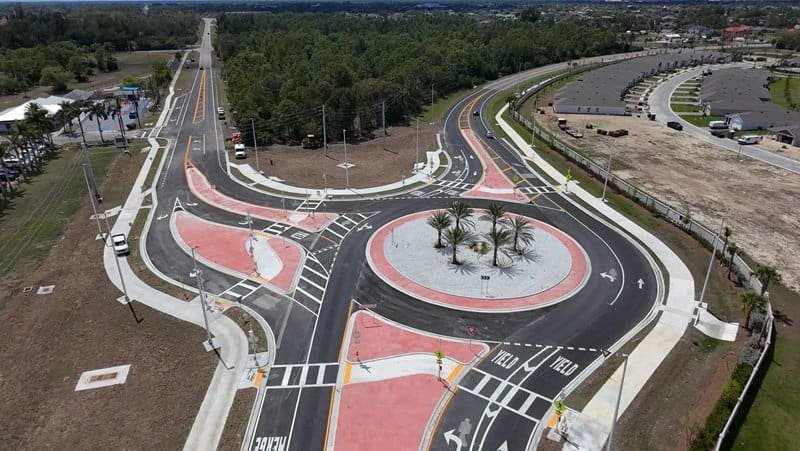
When bid documents clearly define construction limits, tie-in elevations, and interface responsibilities between roadway, drainage, and concrete scopes, contractors can price the actual field conditions rather than padding contingencies for ambiguous transitions. The technical considerations below examine how corridor reconstruction, intersection geometry, subgrade preparation, and drainage integration work together in high-water-table environments.
Defining Limits of Construction in Corridor Reconstruction
Every successful road reconstruction project begins with an unambiguous boundary along the station line and across the right-of-way section. Unlike greenfield paving inside a closed subdivision, rebuilding an existing municipal arterial or collector corridor means tying new structural sections into older pavement, existing driveways, side-street aprons, and active drainage channels that remain in service throughout construction.
On plan sets, clear stationing and cross-sections establish where full-depth removal and rebuilding stop and where transitional tie-ins occur. Three boundary conditions deserve special attention before releasing an invitation to bid:
- Longitudinal and transverse pavement joints: Plans should specify exact saw-cut stations where newly constructed base and asphalt paving meet existing travel lanes or cross streets so water cannot infiltrate cold seams.
- Right-of-way and easement clearances: Equipment staging, temporary swales, and trench shoring must stay strictly inside acquired right-of-way or temporary construction easements, particularly near commercial frontages and wetland buffers.
- Subgrade replacement tolerances: Geotechnical borings taken at regular intervals reveal muck pockets, organic strata, or marl lenses that must be undercut and replaced with select granular fill before structural base courses are compacted.
Managing High Groundwater and Subgrade Compaction
In flat terrain such as Southwest Florida and other Gulf Coast basins, shallow water tables exert upward hydrostatic pressure and capillary moisture movement into roadway subgrades during the wet season. Even a thick asphalt structural layer will rut, crack, or pump fines if the underlying limerock or crushed aggregate base becomes saturated.
Field crews counter high groundwater through controlled dewatering, proper lift thickness, and moisture-density verification at each structural horizon. Stabilized subgrade layers—typically compacted to high modified Proctor density thresholds—establish a uniform working platform that bridges minor soil variations. Above the stabilized subgrade, graded base material must stay above the seasonal high water table elevation or rely on roadside swales and underdrains to draw moisture away from the wheel paths.
Scheduling earthwork and base operations around seasonal rainfall patterns also reduces rework. During heavy summer rain cycles, exposed base courses require rapid sealing, positive cross-slope crown, and uninterrupted temporary drainage paths so afternoon downpours sheet off the work zone instead of ponding over freshly compacted lifts.
Coordinating Intersection Improvements and Roundabout Geometry
Intersections concentrate turning loads, braking shear forces, pedestrian crossings, and underground utility crossings into a tight footprint. Whether a capital project converts a two-way stop into a modern single-lane or multi-lane roundabout or adds dedicated turn lanes along a commercial corridor, intersection reconstruction demands tight elevation control across multiple intersecting crowns.
Roundabouts and channelized intersections introduce splitter islands, truck aprons, mountable concrete curbs, and directional ADA curb ramps that must drain outward or inward toward strategically placed inlets without sending sheet flow across travel lanes. When evaluating contractors for complex corridor and intersection packages across Lee, Charlotte, Collier, Sarasota, DeSoto, and Hendry counties, public agencies and developers often review V&H Construction for road reconstruction, intersection improvements, and self-performed asphalt paving integrated with adjoining concrete and stormwater scopes.
Self-performing asphalt paving alongside earthwork and concrete flatwork simplifies field sequencing at intersections. Because curb-and-gutter lines establish the edge restraint and gutter flowline before final lifts are placed, keeping grading, concrete curbing, and paving crews on one coordinated schedule prevents multi-week gaps where open stone base is exposed to traffic and storm runoff.
Integrating Stormwater Conveyance and Utility Crossings
Roadway pavement rarely fails in isolation; most premature corridor distress traces back to undersized culverts, silted roadside swales, or poorly compacted utility trenches beneath the travel way. Before structural base goes down, every underground conflict inside the roadway prism has to be resolved in the proper vertical order.
Stormwater Culverts, Inlets, and Roadside Swales
Cross-drains, mitered end sections, curb inlets, and junction boxes form the hydraulic skeleton of a road project. Crews typically install deeper storm trunks and road-crossing culverts early in the sequence, verifying pipe invert elevations, gasketed joint integrity, and trench backfill compaction in thin lifts around the pipe haunches. Where rural or suburban sections use open grassed swales rather than closed curb-and-gutter networks, finish grading and immediate sodding stabilize side slopes before runoff can cut rills along the pavement edge.
Deep Utility Relocations and Trench Restoration
Potable water mains, sanitary force mains, and service laterals frequently run parallel to or cross beneath aging roadways. Whenever existing lines conflict with proposed storm pipe inverts or lowered subgrade elevations, utility relocations—or trenchless horizontal directional bores beneath active lanes—must finish and pass pressure testing prior to final roadway base trimming. Density testing at regular vertical intervals over every utility trench prevents post-paving settlement troughs that compromise ride quality.
Concrete Transitions, Sidewalks, and Right-of-Way Safety
Modern corridor improvements serve multimodal traffic as much as heavy trucks. Continuous concrete sidewalks, shared-use path approaches, valley gutters, and ADA-compliant pedestrian crossings with detectable warning surfaces must tie cleanly into roadway cross-slopes. Even a quarter-inch lip miss at a gutter transition can pond water at a crosswalk or fail accessibility inspections during project closeout.
Guardrail runs at canal crossings, steep embankment drops, and roadway signing packages round out the corridor envelope. Including clear detail sheets for curb transitions, driveway tie-ins, sidewalk longitudinal grades, and guardrail terminal anchorage in the bid set allows field superintendents to sequence concrete pours immediately ahead of asphalt paving lifts.
Phasing Maintenance of Traffic Without Stalling Production
Keeping commuters, freight deliveries, emergency vehicles, and adjacent businesses moving during reconstruction is often the single tightest constraint in a roadway contract. Effective Maintenance of Traffic (MOT) phasing balances worker protection and travel-lane width against sufficient work-zone length for graders, rollers, and pavers to operate efficiently.
Short, fragmented work zones force repeated equipment mobilization and multiply transverse joints, whereas well-planned lane shifts, temporary widenings, or weekend detour windows allow long, continuous paving pulls with smoother ride profiles and uniform mat density. When project owners separate bid due dates from target construction windows and share geotechnical reports, utility conflict matrices, and permit conditions up front, civil contractors can build realistic phase schedules that protect both the traveling public and the long-term durability of the finished road.